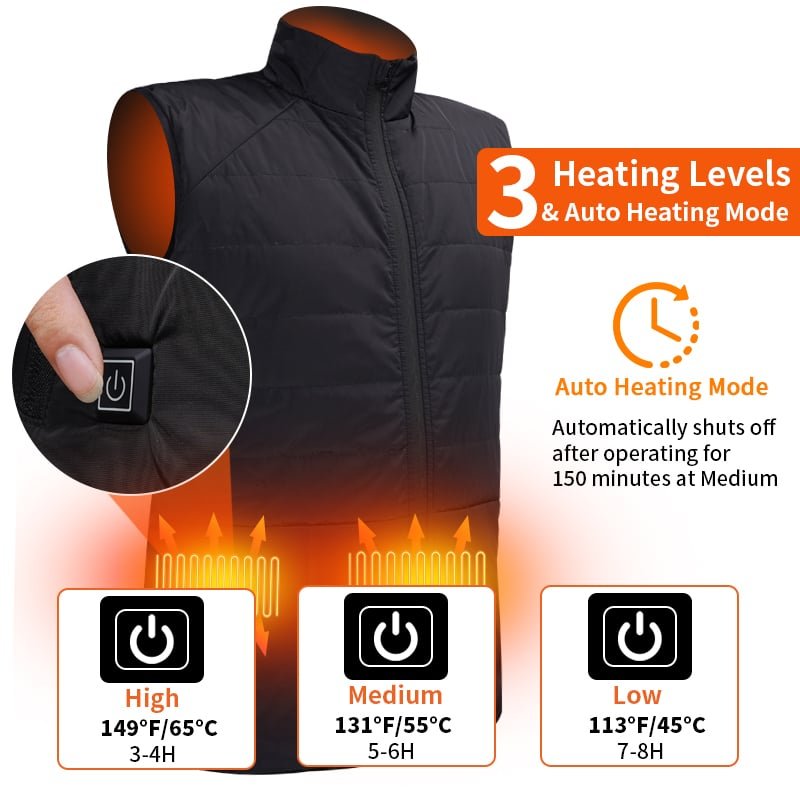

This is not a ranking, and the reason is structural. A heated vest is the one garment in the category that is defined by something the buyer already owns: the outer layer. Hunting, commuting and site work put three different shells over the same vest, and each shell sets a different hard constraint. A list that ignores that is a list of products that fit somebody else’s coat.
Why there is no cross-scenario winner
A glove has to fit inside a boot or a sleeve. A vest has to fit inside a jacket — and unlike a glove, it changes the shape of the layer above it. Too thick and the shoulders of a coat ride up; too tall a collar and a shirt collar will not sit down; a pocket bulge and a suit jacket cannot hang straight. That is why the first question in every scenario below is “what goes over it”, not “how many zones”.
| Scenario | What goes over it | Three hard constraints | How it fails |
|---|---|---|---|
| Hunting | Quiet camo shell, often a pack and a harness | Silent closure; no shine; long low output for a sit | Rip tape heard at twenty metres; a pocket flap that clinks |
| Commuting | Coat, blazer or a thin shell | Low collar; flat pockets; thin enough not to change the drape | Shoulders ride up; the coat stops hanging straight |
| Construction and site work | Hi-vis work jacket or bodywarmer, plus a harness or tool belt | Short hem; flat back; a control that works with gloves | Hem pushed up by a belt; harness presses a zone; pack inaccessible |
Hunting: quiet is a specification, not a preference
A hunting day is mostly a sit, so the thermal requirement is hours of stable low output rather than a burst of heat. The bigger constraint, though, is acoustic. Hook-and-loop closures announce themselves; a metal zip pull against a buckle does the same. Hunting builds use silent closures, recessed pulls and no loose hardware, and that decision has to survive a pack strap and a harness sitting on top of it. Colour matters too: under a camo shell, a shiny black panel with a lit switch is the one thing that can give a position away.
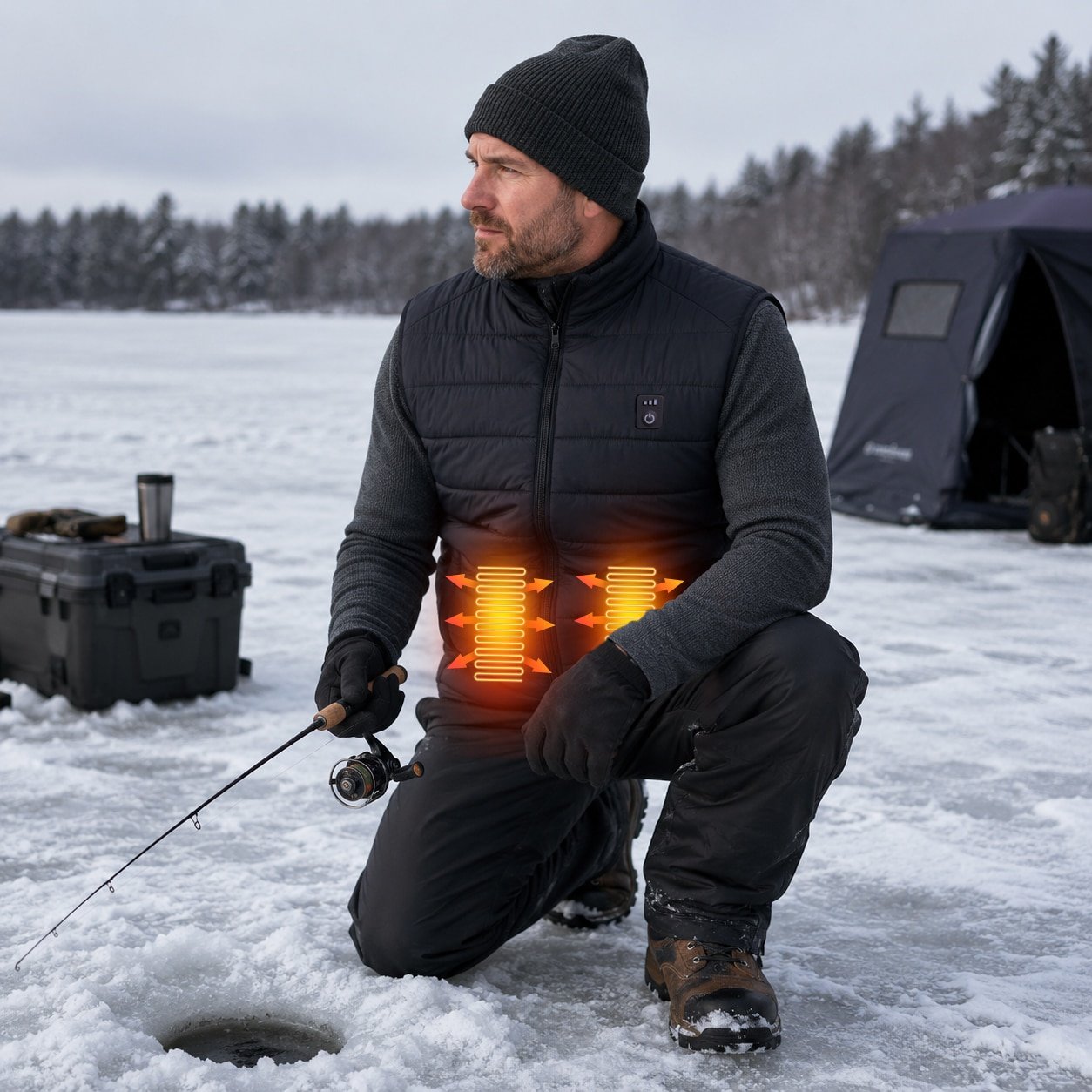
Two practical consequences for a buyer. First, buy capacity for the sit, not for the walk in — the walk is when the body makes its own heat. Second, carry a second pack: on a five-hour sit, a spare is the difference between staying out and going back to the truck.
Commuting: the vest has to disappear
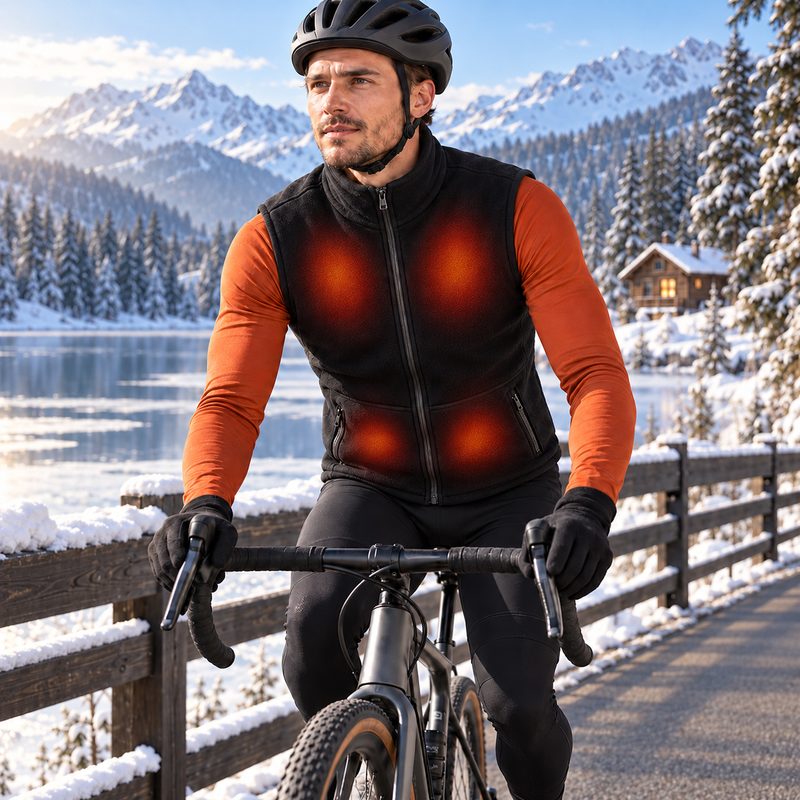
The commuter’s constraint is the opposite of the hunter’s: this vest must be invisible. It goes under a coat, often under a blazer, and the wearer will abandon it after one morning if it changes how the outer layer sits. That means a low or roll collar rather than a stand collar, flat zip pockets instead of patch pockets, no glossy face fabric, and a pack thin enough to vanish in a coat pocket.
The one place a commuter should not compromise is the control. Hands are full — a phone, a bag, a bike, a rail — and the vest is under a coat, so the switch has to be operable by feel through fabric, or by remote. A vest that needs the coat opened to change level gets left on one setting, which usually means it gets left at home.
Site work: the harness and the hem decide
On a site the vest lives under a hi-vis outer layer, and two things go wrong immediately: a long hem gets pushed up by a tool belt and bunches at the waist, and a heating zone placed where a harness crosses gets pressed all day. Both are fit problems, not electrical ones, and both are visible in the first ten minutes of a trial. The buying rule is a short hem, a flat back panel and zones placed between the harness lines rather than under them.
The visibility question is separate and often mishandled. Hi-vis performance is certified on the outer garment — fluorescent background material and retroreflective tape to EN ISO 20471 or ANSI/ISEA 107 — and a heated vest worn underneath neither adds to nor subtracts from that. What the heated vest has to document is the electrical side. That division of claims, and how the harness and tape constraints interact with zone placement, is set out in heated vests versus thermal vests for outdoor work.
The same three specs, chosen differently
| Spec | Hunting | Commuting | Site work |
|---|---|---|---|
| Voltage and capacity | 7.4V, larger pack for a five-hour sit | 3.7V, small pack; a commute is under an hour each way | 5V or 7.4V, pack swappable mid-shift |
| Heat levels | Low and stable for hours | Two levels are enough; quick warm-up matters | Medium held all shift; no fiddling with gloves on |
| Control | Silent, blind-operable, no light | Reachable through a coat, or remote | Large button, glove-operable, protected from knocks |
| Fabric face | Matte, dark, no hardware shine | Smooth enough to slide under a lining | Abrasion-resistant, easy to wipe clean |
Trial it in ten minutes, in the right order
Most vest returns are decided in the first ten minutes of wear, and almost none of that has to do with heat. A five-step trial catches what a spec sheet cannot, and it works for a shop floor, a sample room or a customer trying one at home.
- Put the outer layer on over it. Nothing else tells you whether the shoulders ride up. If they do, the vest is too thick for that coat and no setting will fix it.
- Raise both arms overhead, then lower them. A vest that climbs at the hem or pulls at the armholes will be uncomfortable within an hour, and the armhole is the fault.
- Look down at the collar. A stand collar under a shirt collar is the single most common commuter complaint, and it is visible in a mirror in three seconds.
- Find the switch with gloves on and your eyes forward. If it takes more than a few seconds, the wearer will leave it on one setting for the whole season.
- Sit down for five minutes. Sit in a car seat, a chair, or on the ground with a pack on. This is where a pocket lead creases and where a harness presses a zone — the two faults that only appear after an hour of real use.
None of these five steps is in a product listing, and all of them map directly to the constraints in this article. For a brand, they are also a ready-made retailer instruction card, which is cheaper than a return.
What actually changed for 2026 buyers
Three shifts are worth knowing, and none of them is about wattage. USB-C has become the default charging port on small packs, which makes a commuter vest chargeable from the same cable as a phone but also introduces a negotiation step some cheap cables fail. Remote and app control has moved from premium to normal, which matters most for the hunting scenario. And battery compliance has tightened: CE and UKCA marking, IEC 62133 for cells, UN38.3 for air freight, and for the Chinese market GB 47372-2026 with CCC. A 2026 specification should name all four, because the importer owns whatever the pack and the box claim.
What has not changed is the structural point. Whichever scenario a buyer is outfitting, the vest is the layer that has to fit inside something else, and the measurement that decides the purchase is the one taken with the outer layer on. The zone and capacity checklist for that decision is in the heated vest buying guide, and the failure side in common heated vest problems.
Custom heated vests for hunting, commuting and workwear ranges
Dr. Warm builds the same platform three ways: matte quiet-face builds with silent closures for hunting, low-collar thin builds for commuting, and short-hem workwear builds for hi-vis layering. Battery options from 3.7V to 12V, remote or app control, detachable packs, and compliance documentation for CE, UKCA, IEC 62133, UN38.3 and GB 47372-2026. OEM from 100 pieces, ODM from 500.

Frequently Asked Questions
Which heated vest is best for hunting?
A quiet build: silent closures instead of hook-and-loop, recessed pulls, no loose hardware, and a matte face with no lit switch. For a long sit, low and stable heat on a larger 7.4V pack beats a high burst on a small one.
Can a heated vest be worn under a suit jacket or overcoat?
Yes, if the build is made for it: a low or roll collar instead of a stand collar, flat zip pockets instead of patch pockets, and a pack thin enough to vanish in a coat pocket. The test is whether the outer layer still hangs the way it did without the vest.
Does a heated vest count as hi-vis clothing?
No. Hi-vis performance is certified on the outer garment through fluorescent background material and retroreflective tape to EN ISO 20471 or ANSI/ISEA 107, and a heated vest worn underneath neither adds to nor subtracts from that. What the heated vest documents is the electrical side of the system.
How much battery does a commute need?
A commute is usually under an hour each way, so a small 3.7V pack on two levels is enough. USB-C charging from the same cable as a phone matters more than capacity, and quick warm-up matters more than peak temperature.