Most advice on slim versus loose heated vests treats it as a sizing question. It is not. Fit decides where the heating element sits relative to your skin, how much still air stays trapped around your body, and where the battery ends up — three things that change how warm the same heating system feels. Two vests with identical elements and identical battery packs can perform noticeably differently on the same person because one hugs the body and the other does not.
The useful question is therefore not “which fit is better” but “which fit works when I wear it in the layer I actually wear it in”. This page works through that, including the two cases where neither fit is right.
Fit decides the path the heat takes to your skin
A heated vest warms you by two routes at once. The first is direct conduction: the element heats, the fabric over it heats, and that fabric touches you. The shorter the distance and the fewer layers in between, the more of the element’s output reaches you. The second is trapped air: still air is the best insulator most clothing has, and a garment that does not touch you everywhere leaves a layer of it in place. Those two routes pull in opposite directions, and fit is the dial that trades one for the other.

Slim fit: the shortest path, the thinnest buffer
A slim heated vest keeps the element close to the body. That means less material and less air between the heat source and your skin, so a given setting feels warmer sooner, and the whole vest moves with you instead of swinging away from your back when you lean forward. It fits under a jacket without fighting it, which is why slim is the right shape for a mid layer under a shell or a coat.
The cost is the air layer. A slim vest that touches you across most of the torso has given up the insulation that loose fabric provides, so it loses heat faster when wind reaches it and feels colder the moment you switch the power off. It also has less room for a thick sweater underneath; wear a heavy knit under a slim vest and the vest stops being slim, the element is pushed away from the body unevenly, and the zip line pulls. Slim works best over a base layer or a thin mid layer, not over a heavy one.
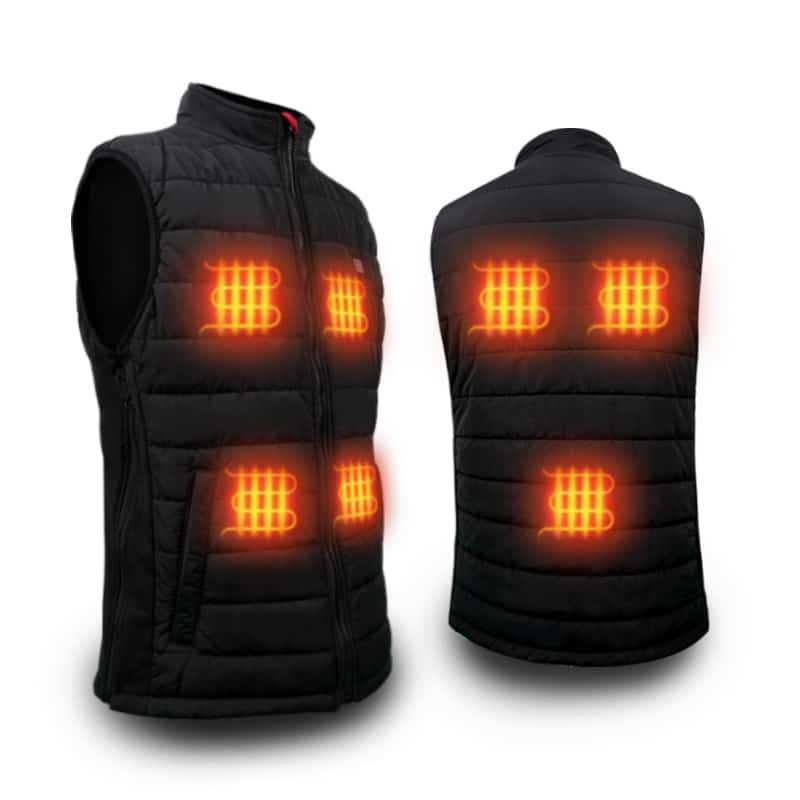
Loose fit: air is insulation, distance is loss
A loose heated vest works the other way. There is a gap between the fabric and your body, and that gap of still air insulates, so the vest holds warmth after the power drops and tolerates wind better than a tight one. It also fits over whatever you are already wearing, which makes it the practical choice for someone who puts it on over a sweater at a desk, in a car, or around a site where layers go on and off through the day.
The cost here is distance. The element is further from your skin, so more of its output warms the air inside the vest rather than you directly, and the sensation is a slower, more diffuse warmth rather than an immediate one. A loose vest also gives wind a path: it enters at the armholes and the hem and travels up, which is why an open bottom on a loose vest can undo much of what the element does. If the vest has a drawcord at the hem or a hem that cinches, use it — on a loose fit it changes the result more than the heat setting does.
| What changes | Slim fit | Loose fit |
|---|---|---|
| Distance from element to skin | One thin layer — fastest perceived warmth | Fabric plus air gap — slower, more even |
| Trapped still air | Minimal — little heat held after power off | Significant — holds warmth between settings |
| Wind paths | Few gaps, but no buffer when wind penetrates | Armholes and hem leak unless cinched |
| What fits underneath | Base layer or thin mid only | Sweater, hoodie, work shirt |
| Battery position | Pressed against the body at waist or chest | Can sit lower and flatter |
| Best layer role | Mid layer under a shell or coat | Outer layer indoors, in cars, on site |
The layer you wear it in is the real decision
Read down that table and the argument resolves into one rule: choose the fit that matches the layer role. A vest worn under something should be slim, because bulk under a shell steals fit from the shell and puts the element at an angle to your body. A vest worn over something, as the outer layer, should be loose, because it has to fit over what you already have on and because nothing outside it is holding the warm air in.
| How you will wear it | Choose | Reason |
|---|---|---|
| Under a hard shell, ski jacket or winter coat | Slim | The outer garment already blocks wind; extra bulk only distorts its fit |
| As the outermost layer, outdoors and moving | Loose, hem cinched | Nothing outside it traps air, so the vest must trap its own |
| At a desk, in a car, on a site — on and off all day | Loose | Goes over existing layers without removing them |
| High-output activity where you sweat | Slim, over a wicking base | Close contact passes heat through a damp base layer better than an air gap does |
| Under a coat and over a thick sweater at once | Neither — go one size up in slim or use a jacket | A slim vest over a heavy knit pushes the element off the body unevenly |
Battery position and the small reasons vests get returned
Fit also moves the battery, and the battery is the part people complain about after two weeks. On a slim vest the pocket sits against the body at the waist or the chest, and a pack that presses into a hip bone becomes noticeable on a long drive. On a loose vest the same pack can hang lower and flatter, which is more comfortable standing and less comfortable when you bend forward. None of that shows up in a two-minute try-on; it shows up on the third hour.
Three other fit-related returns are worth knowing before you buy. Armholes that are too tight on a slim vest restrict reach and pull the element across the chest. A hem that flares on a loose vest lets wind straight up the back. And length: a vest that ends exactly at the waistband of trousers creates a cold band when you sit, because the two garments separate — a vest cut slightly longer or shorter avoids the gap. Check all three with the vest on and your arms raised, not standing still in front of a mirror.
Choosing when you sit between two sizes
Between sizes, the layer rule still decides. If the vest will be worn under something, take the smaller size — a slim vest that is slightly snug behaves correctly, while one size up behaves like a loose vest with the wrong length. If it will be worn as an outer layer, take the larger size and use the hem cinch, because an outer vest that cannot close over a sweater gets left at home. Judge it wearing the thickest layer you realistically expect to pair with it, and do three things while it is on: raise both arms, reach forward as if taking a bag from a seat, and sit down. Those three movements reveal armhole tightness, back lift and hem separation faster than any measurement chart.
For brands: fit changes the build, not just the size run
In an OEM or ODM program, slim and loose are two constructions rather than two patterns of one garment. A slim vest usually wants a denser face fabric to resist wind it no longer buffers, shorter wiring runs between panels, and a battery pocket positioned for close-body wear. A loose vest tolerates a lighter shell, needs longer element runs to cover a larger area evenly, and often benefits from a hem adjuster that a slim version does not need. Specifying both from one platform is possible, but the element layout and pocket placement should be reviewed per fit.
Our minimums are OEM orders from 100 units and ODM projects from 500 units per style. Voltage tiers run 3.7V, 5V, 7.4V and 12V, with 24V reserved for custom builds, and water resistance is IPX4 as standard with IPX5 available as an option on most lines. For the wider selection picture, our heated vest buying guide covers zones, battery life and care, and buyers deciding whether a vest is the right category at all should start with heated jackets versus heated vests.
The short answer
Buy the fit that matches the layer you will wear it in. Slim under a shell, because the shell handles the wind and you want the shortest path from element to skin. Loose as an outer layer, because the vest has to trap its own air and fit over what you already have on. Both are correct answers to different questions, and the only wrong answer is choosing the fit you like the look of and then wearing it in the other role.
Frequently Asked Questions
Is a slim or a loose heated vest warmer?
Neither is warmer in isolation. A slim vest shortens the distance from element to skin, so a given setting feels warmer sooner, but it traps little air and loses heat quickly once the power drops. A loose vest insulates better with trapped air, but the element sits further away. Which feels warmer depends on the layer you wear it in, not on the fit alone.
Should I size up in a heated vest?
Only if you plan to wear it as an outer layer over a sweater. Sizing up a slim vest gives you a garment with loose behaviour and a longer body, not a better mid layer. If it will be worn under a jacket, take your normal size or the smaller of two sizes, judged while wearing the thickest layer you actually expect to pair with it.
Can a loose heated vest be worn under a jacket?
It can, but check two things first: whether it bunches across the chest where the jacket fits tightest, and whether the armholes still allow a full reach. A loose vest under a technical shell adds bulk exactly where the shell has no room, which is why slim is usually the better mid layer.
Does the fit change where the battery sits?
Yes. A slim vest holds the pack against the body at the waist or chest, where a hard pack can press on a hip on a long drive. A loose vest lets the same pack hang lower and flatter, which is more comfortable standing but less comfortable when you bend forward. Try sitting down with the pack fitted before deciding.