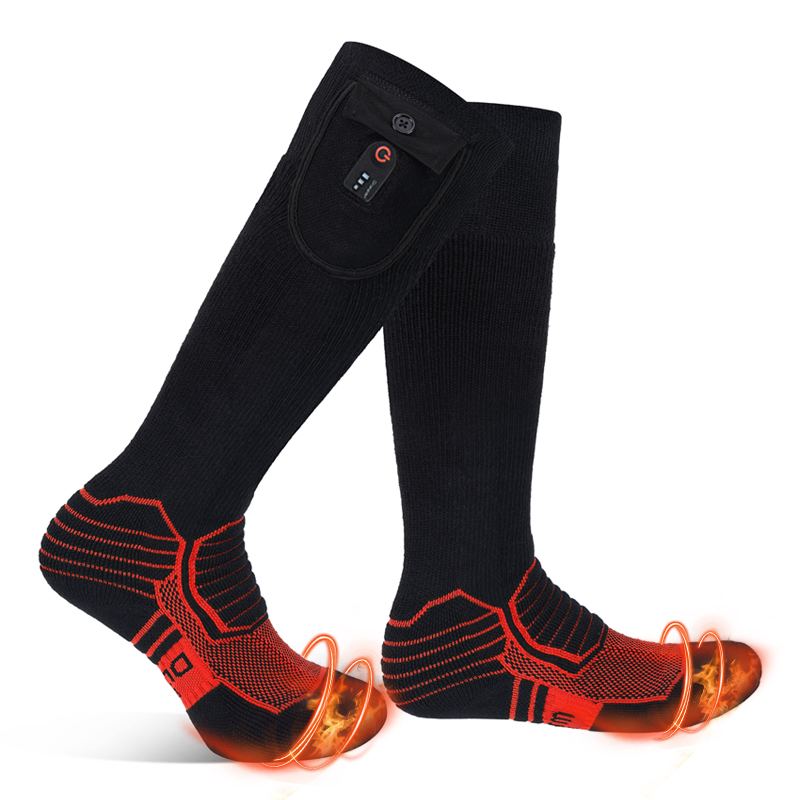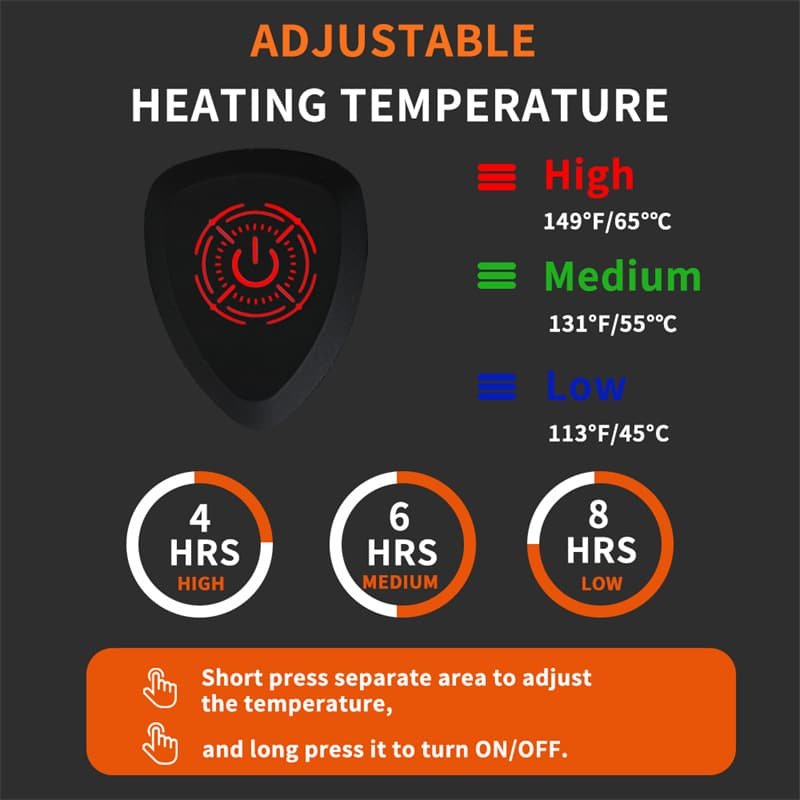

Short answer: a rechargeable heated sock running a 3.7V 2,200mAh pack (8.1Wh) gives about 5–7 hours on low, 3–4 hours on medium and 2–3 hours on high in freezing weather. A 7.4V 2,200mAh dual-cell build (16.3Wh) roughly doubles that, to 8–11 hours on low. The “6–10 hours” quoted in most listings is the low-setting, indoor, thin-sock, loose-fit number — and the boot you wear changes the result by more than the battery choice does.
That last point is the one buyers get wrong. A heated sock is the only heated product in the range that is worn inside another piece of equipment, and that equipment — its shell, its fit, its ventilation — sits between the heating element and the outside air. This guide covers the real numbers, why a sock outlasts a glove on the identical pack, and the three conditions that quietly halve the claim.
Why a sock outlasts a glove on the same battery
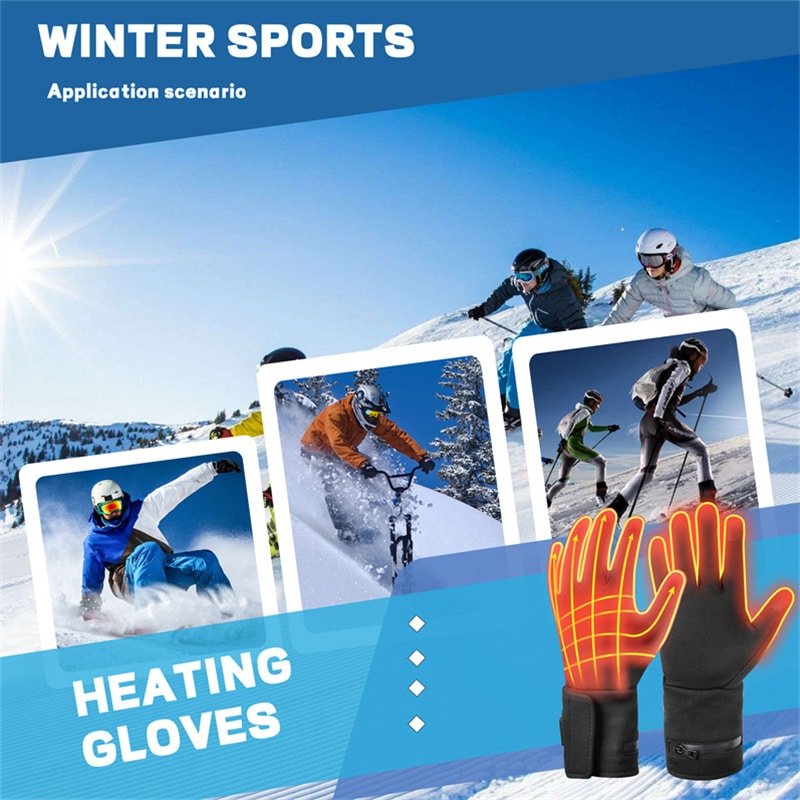
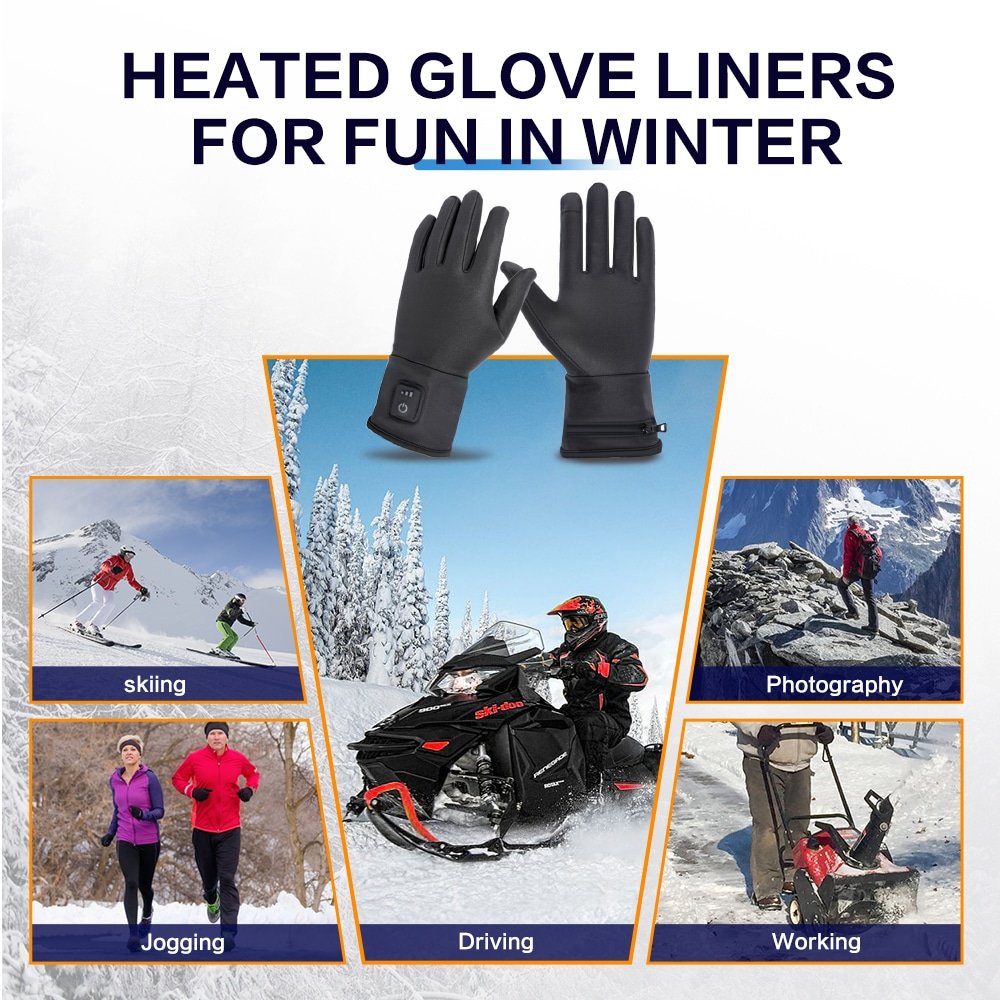
Put the same 8.1Wh pack in a glove and in a sock and the sock runs roughly an hour longer on every setting. The reason is not the element or the controller — it is that a foot inside a boot is insulated on five sides, while a glove is the outermost layer with wind on it and a bare wrist at the cuff.
| Garment | Pack | Low | Medium | High |
|---|---|---|---|---|
| Heated gloves | 3.7V 2,200mAh | 4–6 h | 3–4 h | 1.5–2 h |
| Heated socks | 3.7V 2,200mAh | 5–7 h | 3–4 h | 2–3 h |
| Heated insoles | 3.7V 2,200mAh | 5–7 h | 3–4 h | 2–3 h |
Socks and insoles land on the same figures because they share the boot. If you want the glove side of this comparison in detail, including the watt-hour arithmetic behind every claim, our heated glove runtime guide works through it; the full energy table across every system is in our battery lifespan data.
The boot decides more than the battery does
Three things change when a sock goes into a shoe, and all three move the runtime:
- Compression. A tight boot presses the knit and the element flat against the foot, collapsing the air layer that was doing the insulating. Tight also means less blood flow, so the foot feels colder on the same setting and the wearer reaches for high.
- Ventilation. A ski boot is a sealed insulated shell; a running shoe is a mesh bag. The same sock can lose a third of its runtime in the second case, because heat that stays in a boot leaves through a mesh upper almost immediately.
- What is under the foot. Heat travels down into a cold sole as readily as it travels up into the foot. A thermally reflective insole blocks that path and pushes the energy the element produces into the foot instead of the floor.
This is why a runtime figure is only meaningful with the footwear attached to it. A supplier quoting ten hours should be able to tell you whether that was measured in a ski boot, a work boot or a trainer — and whether the sock was compressed or loose. If they cannot, the number is decoration.
Sweat costs more runtime than cold does
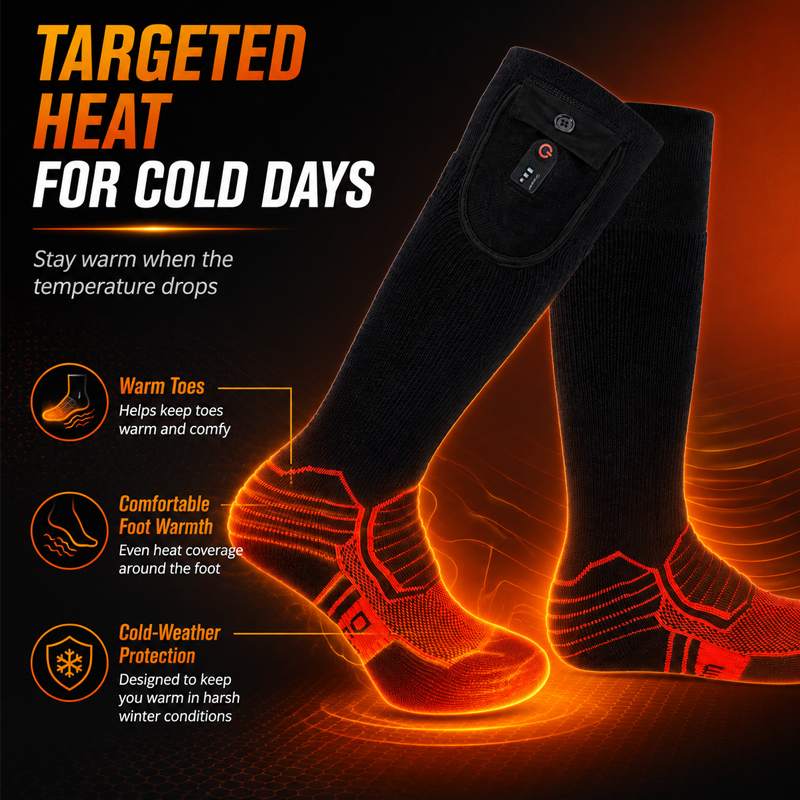
Feet sweat — a lot, and continuously, inside a boot that does not breathe. A damp sock conducts heat away from the skin and then loses more to evaporation, so the foot feels colder while the element is drawing exactly the same power. The wearer responds the only way they can: they turn it up. That is where the extra hours disappear, and it is not visible on any battery datasheet.
Two design answers matter here, and neither of them is the word “waterproof”. The knit has to move moisture away from the sole, and the pack has to come out before washing — every time. A sock that traps sweat is a sock that reads as cold at hour two on a full battery. For IP rating, IPX4 is our standard and IPX5 is available as an option on request; anything sold as sealed against full immersion is a different product category.
Runtime by pack and heat level
Measured at 20–25°C ambient in a boot, on a wearer who is walking rather than sitting still. Plan a session on the low figure and treat high as a warm-up mode, not a mode you live in.
| Pack | Energy | Low | Medium | High |
|---|---|---|---|---|
| 3.7V 2,200mAh | 8.1Wh | 5–7 h | 3–4 h | 2–3 h |
| 3.7V 3,200mAh | 11.8Wh | 7–10 h | 4–6 h | 3–4 h |
| 7.4V 2,200mAh (dual cell) | 16.3Wh | 8–11 h | 6–8 h | 3.5–5 h |
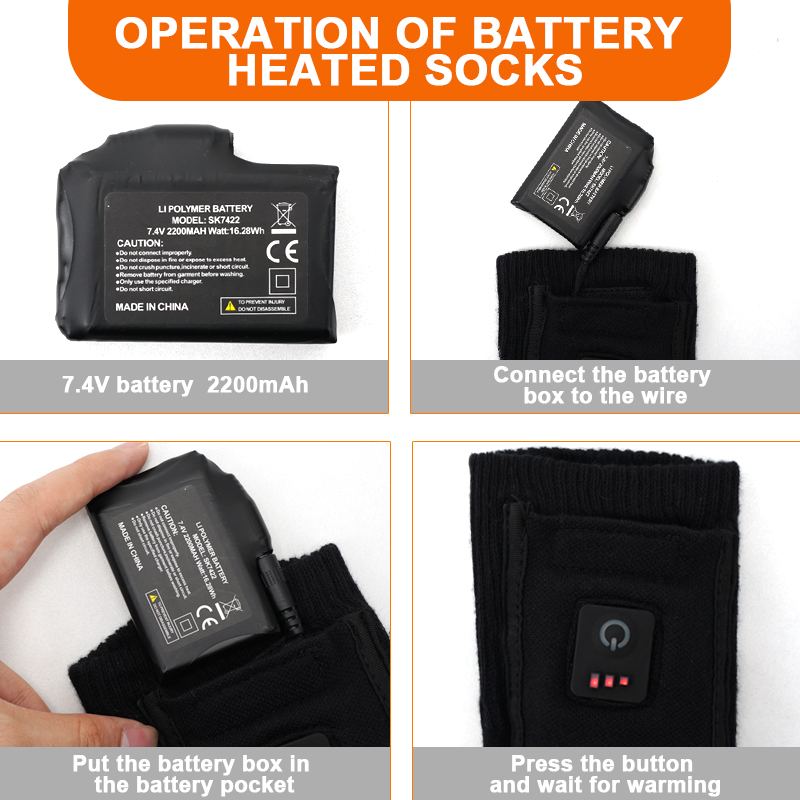
The 2,200mAh 3.7V row is our published figure; the other two are scaled by watt-hours, since a circuit drawing the same power runs proportionally longer. Note also that a 7.4V 2,200mAh pack is printed as 16.28Wh on the case — the same 16.3Wh, rounded. If a quotation gives you milliamp-hours without the voltage, you cannot price the runtime at all; our 3.7V vs 7.4V heated sock comparison covers how the two platforms differ in pack bulk and calf support.
What each of the three settings is actually for
Most runtime complaints come from using one setting for everything. The three levels are not three strengths of the same experience — they map to three different kinds of session, and the table above only makes sense if the buyer is told which one they are reading.
Low — long, still sessions
Low is for the wearer who is not moving much: ice fishing, a deer stand, a stadium seat, a cold office. The foot is not generating heat of its own, so the sock has to hold a temperature rather than build one, and 5–7 hours is a realistic session length. This is the setting the headline hours belong to.
Medium — walking, and the honest number
Medium is the setting a walking or working wearer actually lives in, and 3–4 hours is what that buys. Movement pushes blood back into the foot, which raises comfort faster than the element alone can, so medium rarely needs to be overridden. If a buyer can only remember one figure from this page, it should be this one.
High — a warm-up tool, not a mode
High exists to get a cold foot to temperature in a few minutes, or to recover after a break outdoors. Held continuously it flattens a 16.3Wh pack in under five hours and leaves nothing for the ride home. Merchandising it as the default setting is the fastest way to generate returns from customers who were told eight hours and got three.
Where the “10 hours” claim comes from
Ten hours from a sock pack is not usually a lie. It is four favourable conditions stacked together: low setting, indoor ambient, a thin sock, and a loose fit with no compression. Reverse the arithmetic and you can see what it implies — 8.1Wh spread over 10 hours is 0.8W of heating, which is a warmth-maintenance level rather than a heating level.
Our own 5–7 hour low figure works out to roughly 1.2–1.6W, which is what keeps a toe warm at -5°C rather than merely less cold. Both are honest products. Only one of them survives a ski lift.
Five things that actually add hours
- Fix the fit before the battery. If the boot presses on the toe box, no pack size will help. A finger’s width of room over the toes is worth more runtime than an extra cell.
- Add a reflective insole. It stops the element from heating the sole of the boot, which is the largest heat sink in the system.
- Warm up on high, then drop to medium. A cold start is the most expensive phase; eight minutes on high followed by medium is cheaper across a day than hours on high.
- Carry the spare against your body. An inside jacket pocket keeps the second pack at 20°C instead of -5°C, and a warm pack delivers close to its rating.
- Change the sock at the same time as the pack. A dry sock on the same setting feels warmer, which is the same as saving a level of power.
Specifying socks for a market
Four inputs settle the specification: the coldest ambient the sock must work in, the footwear it will be worn with, the length of a typical session, and whether a spare pack ships in the box. A sock sold into ski retail and a sock sold into workwear need different packs for the same promise, because the boots are not comparable.
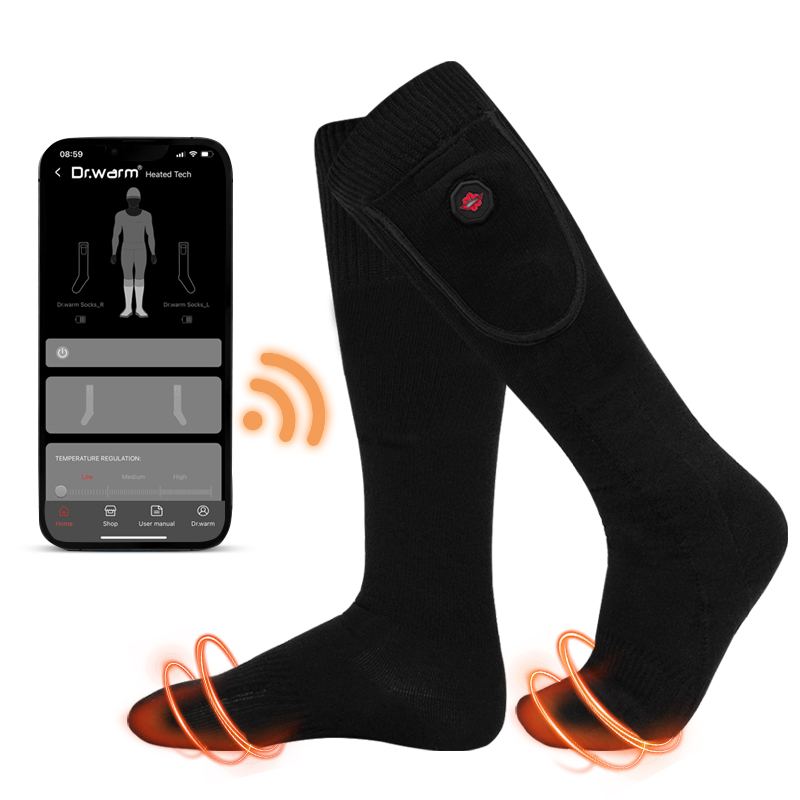
Dr. Warm builds rechargeable heated socks on 3.7V and 7.4V platforms for brands, distributors and retailers, covering element layout, pack and charger matching, knit and cuff construction, private labelling and retail packaging. Send the market, the footwear and the session length, and we will specify the pack around it through our OEM and ODM service. The finished range is on our heated sock category page.
Frequently Asked Questions
Can heated socks really last 10 hours?
On low, indoors, in a thin sock with a loose fit — yes, and the arithmetic shows what that means: 8.1Wh spread over 10 hours is about 0.8W of heating. Our own low-setting figure for a 3.7V 2,200mAh sock in a boot is 5-7 hours, and a 7.4V 2,200mAh build reaches 8-11 hours on low. Both are honest; only the second one is a full day outdoors.
Why do my heated socks last less in ski boots than at home?
Three reasons, none of them the battery. A tight boot presses the knit and the element flat, collapsing the air layer that insulates; a ski boot shell loses heat differently from a trainer’s mesh upper; and whatever sits under the foot acts as a heat sink, pulling energy down into the sole unless an insulating insole blocks it.
Do heated socks stop working when they get damp?
They keep heating, but the wearer feels colder. Wet knit conducts heat away from the skin and then loses more to evaporation, so the same power produces less comfort and the setting gets turned up. That is where the extra hours disappear. The fix is a knit that moves moisture away from the sole and a pack that comes out before washing.
Is one 7.4V pack or two 3.7V packs better for a long day out?
Two 3.7V packs, for most wearers. Each is lighter on the calf at any moment, the pair usually costs less to build than one 16.3Wh dual-cell pack, and swapping at lunch covers a full day. A single larger pack wins only when the wearer cannot stop to swap, or when the heated area needs the extra power to reach temperature at all.