
Ordinary thermal socks slow heat loss. Heated socks add heat. On a work site that difference matters far less than two things most comparisons ignore: how much the worker moves, and how much room the boot has left.
Short answer: on site, the duty cycle decides
A static worker — a gate guard, a machine operator, a cold-store picker — loses heat through the sole into frozen ground and cannot generate enough of it back. For them, added heat is the only thing that changes the day. A moving worker — groundworks, unloading, forestry — generates plenty of heat and then loses it to sweat; for them a dry wool sock and a boot that is not clamped shut will outperform anything with a battery in it. Same temperature, opposite answer.
So the honest version of the question is not which sock is better, but which failure the buyer is insuring against: heat deficit, or moisture. Everything below works through that, plus the two facts that decide whether the answer survives contact with a real shift — how much volume the boot has, and how many packs a worker actually needs.
The boot decides before the sock does
Safety footwear is a fixed-volume machine. There is a toe cap, a penetration-resistant plate in the sole, often a metatarsal guard, plus a padded collar and a zip or lace closure. None of that volume grows when a heating layer is added, so every millimetre the sock gains is taken from the foot.
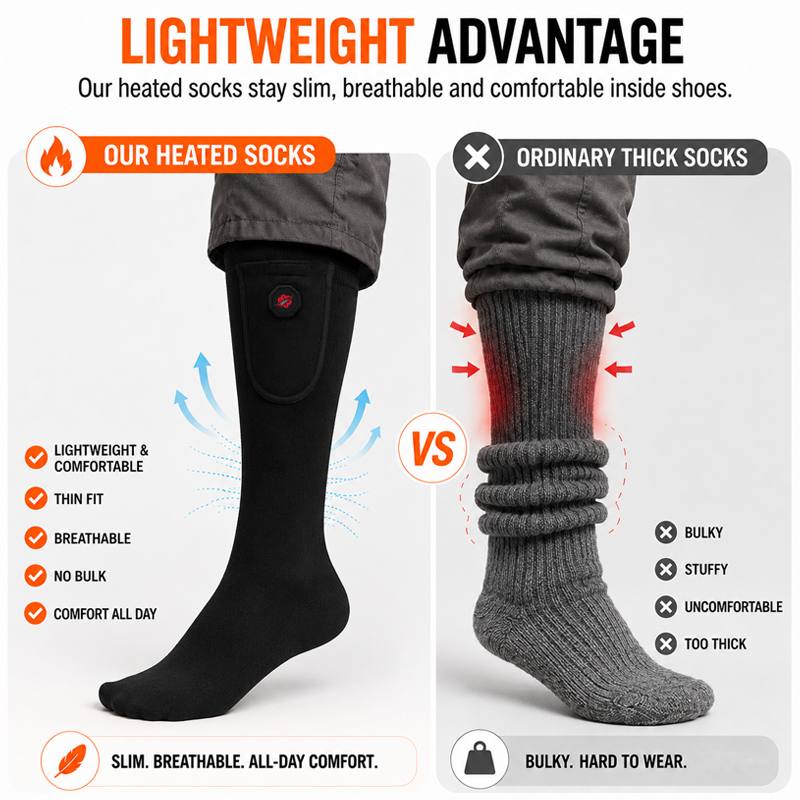
Work boots are normally fitted with a thin sock, often late in the day when the foot is at its largest. Fit the boot with the sock that will actually be worn, or measure the sock being replaced — flat and relaxed, not stretched over a foot. A sock that changes instep height changes where the laces close; a sock that changes toe height turns a correctly sized boot into a tight one.
The second effect is specific to safety boots and almost never mentioned. The penetration-resistant plate does not flex. On a hiking boot the sole element gets some flex relief; on an S3 boot the element is compressed between the foot and an unyielding plate on every step, and it takes that load on a small area instead of spreading it along the sole. That is why element placement is worth a question. For standing work, heat concentrated at the toes and forefoot survives longer than a full-sole element that spends the shift being pinched — the same structural argument that governs industrial heated sock design.
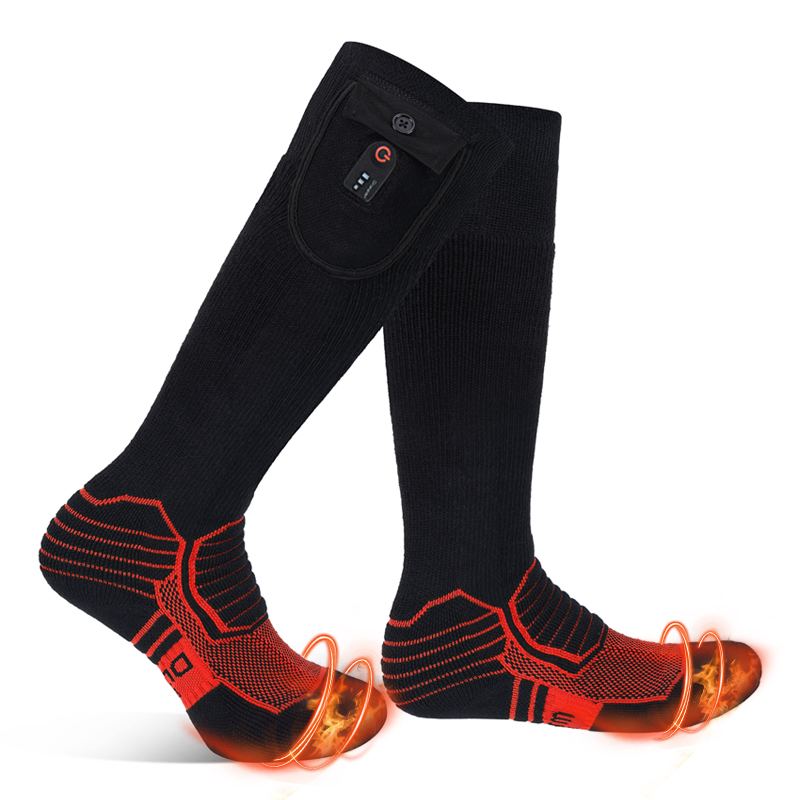
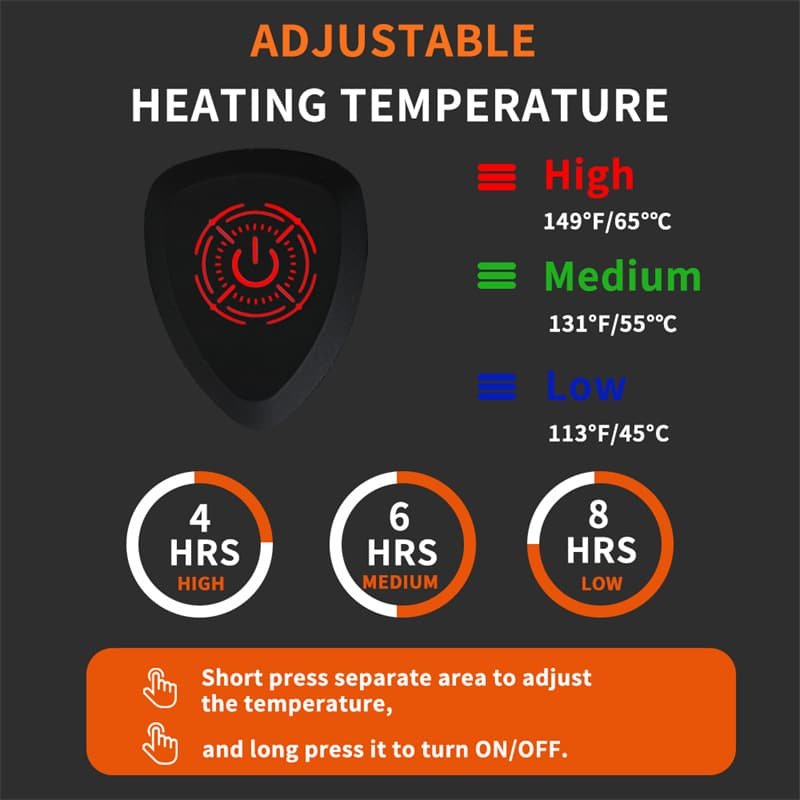
Third, the pack. A calf-mounted pack works with a wide shaft and fights with a tight zip panel, a padded collar or a gaiter. If the crew wears knee pads or gaiters, the pocket is under pressure all day. Ask where the pack sits once the boot is laced up, not where it sits in the product photo; and check that the button can be pressed with a work glove on, and is not pressed by accident while the boot goes on.

The duty cycle test: heat deficit or sweat?
Three profiles cover most cold-weather work, and each one fails in a different way. Pick the profile first, then the sock.
| Worker profile | What the body is producing | The real problem | What wins |
|---|---|---|---|
| Static: gate, machine operator, spotter | Very little internal heat | Conduction into frozen ground through the sole | Added heat on a low setting; insulation alone cannot close the gap |
| Intermittent: site labour, plant operator, unloading | Bursts of heat, then standstill | Sweat during the burst, cold during the wait | Control simplicity: one low setting all shift, glove-operable switch, second pack |
| Continuous: forestry, steep ground, stairs | More heat than it needs | Sweat trapped inside a closed boot | Dry wool and boot discipline; heat only for the stops |
| Cold store: cycling in and out of a chilled chamber | Moderate, but the ambient swings | Condensation on every exit | IP-rated electronics plus a drying routine, not more capacity |
The rule of thumb that survives a real shift: if the worker stands still for more than about twenty minutes at a time in sub-zero, added heat earns its money. If the worker never stops and is damp at the end of the shift, the money is better spent on dry socks and boot care — a wet insulation layer is colder than a dry one no matter what is printed on the pack.
The cold-store profile is worth separating because it breaks both rules. A picker cycling between a chamber held around −18 °C to −25 °C and a warm loading bay is not cold-limited, they are moisture-limited: the sock condenses on every exit, and the electronics see that water every day. That is a care problem before it is a heating problem, which is the same conclusion that governs waterproof heated sock care.

Shift maths: how many packs, not how many watts
Runtime questions get asked in watts and should be answered in hours-in-the-cold. An eight-hour shift is rarely eight hours outdoors, and a twelve-hour shift with a two-hour break is ten. Count only the time the pack is switched on.
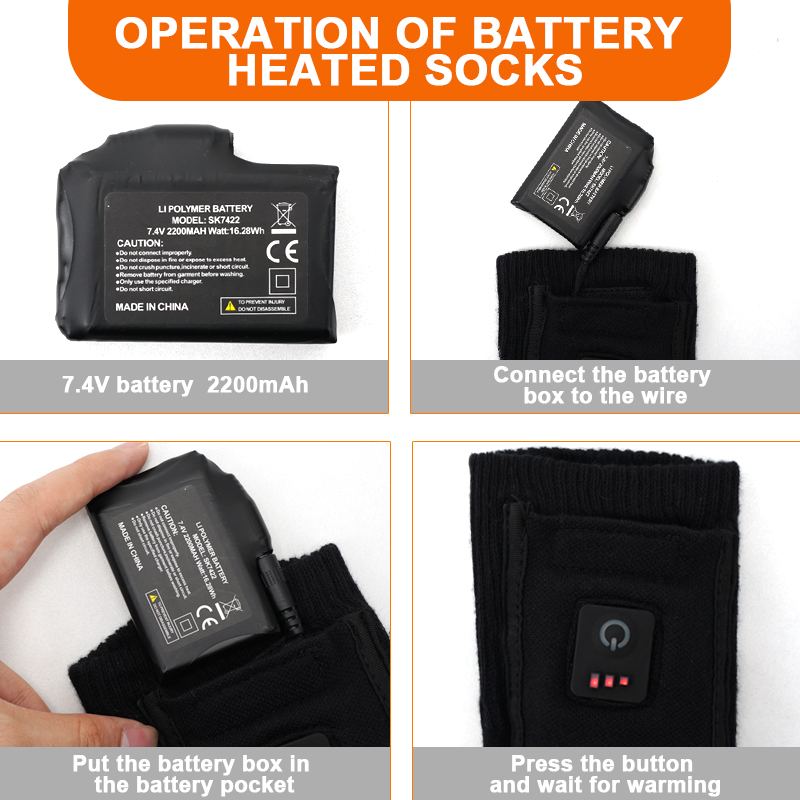
Nominal energy is simply voltage multiplied by capacity: 3.7V at 3,200mAh is about 11.8Wh, 7.4V at 3,000mAh is 22.2Wh, and that arithmetic is the whole reason the higher-voltage builds exist. Run the same sum for any offer and the tiers stop being marketing — see battery capacity for heated socks for the full comparison.
| Platform | Standard capacities | Nominal energy | Charger | Where it fits |
|---|---|---|---|---|
| 3.7V | 2,200 / 2,500 / 3,200 / 5,000mAh | 8.1 / 9.3 / 11.8 / 18.5Wh | 5V 2A | Thin boots, light duty, single shifts |
| 5V | 10,000 / 20,000mAh | 50 / 100Wh | 5V 2A or 3A | Crews that also want a power bank; heavier pack |
| 7.4V | 2,200 / 3,000 / 4,000mAh | 16.3 / 22.2 / 29.6Wh | 8.4V 1.5A | Long shifts, cold store, double shifts |
| 12V | 5,000mAh | 60Wh | 5V 3A | High-output builds, quoted as a custom option |
Charging is the part that gets missed. Packs recover in roughly 3.5 to 19 hours depending on model and capacity, and each platform needs its own charger — a 7.4V pack will not come back on a 5V lead. If the turnaround between shifts is shorter than the charge time, the answer is a second pack rather than a bigger one.
Charging forty packs at a depot needs sockets, a labelled rack and numbers printed on the packs. Unlabelled packs get mixed, and a 3.7V pack sent out with a 7.4V sock is a support ticket every week, which is exactly the failure pattern described in why heated socks fail to heat up.
What a work sock certificate covers, and what it does not
Safety footwear carries the PPE certification — EN ISO 20345 and its S-classes for toe protection, penetration resistance and slip resistance. A sock does not become PPE by being worn inside a certified boot, and a heated sock cannot be certified as footwear. If a tender asks for a certified heated work sock, the useful reply is a question: certified to what, and by whom?
What can actually be documented, and what a buyer should ask for: battery and cell compliance — CE and UKCA marking, IEC 62133 for the cells, UN38.3 for air freight, RoHS and REACH for materials, and for the Chinese market GB 47372-2026 with CCC alongside them. Then the ingress rating of the electronics: IPX4 is the usual standard for heated socks and IPX5 is available on request, and both are splash protection rather than immersion. Then the controller’s cut-out and over-current behaviour, in writing.
One claim to refuse on principle is anti-static or ESD-safe. A garment with a lithium pack is a poor candidate for an ESD claim, and where the site’s footwear specification requires ESD properties, the sock must not be described as providing them. Anything printed on the pack, the box or the sock is a claim the importer owns once it crosses the border.
The kit decision: pairs per worker, not pairs per order
The most expensive mistake in a workwear programme is buying one pair per worker. A work sock is washed after every shift, and washing is the highest-risk event in the life of a heated sock — the plug, the connector and the element layer all meet water and handling they were not designed for. One pair per worker means that pair is washed daily, dried overnight in a wet room and plugged in still damp. That is a scheduling problem, not a durability problem, and it is solved with arithmetic rather than with a better sock.
Two pairs per worker is the practical minimum: one worn, one drying. It also halves the wash cycles each pair sees across a season. Add a second pack where there is no charging on site, and keep packs as a stock item — a pack that cannot be replaced retires the pair, and packs age faster than the knit does.
Sizing is a distribution, not a size. A crew is not one foot, and the middle sizes run out first; buy the range the crew actually uses. Cut-to-fit is a poor choice for a fleet purchase because it moves a manufacturing tolerance into a pair of scissors in a changing room.
Then the number that decides the programme is cost per worker-season, not unit price: pairs per worker multiplied by crew size, plus replacement packs, plus the failed-pair rate. Which loops back to the first question — a static crew on a cold site will wear the socks every shift and wear them out, while a moving crew will leave them in the locker and the programme will look like an expensive mistake.
When ordinary thermal socks are still the right answer
There are four situations where the battery does not pay, and it is worth being straight about them.
- Movement-heavy work in moderate cold. Sweat, not cold, is the limiting factor, and a pack adds weight to a boot that is already wet.
- Sites that restrict personal lithium devices. Some industrial and mining sites do. If the site bans them, the decision has been made for you.
- Contract laundering. A heated sock will not survive an industrial wash cycle, so if the kit goes into a high-temperature laundry the heated pairs stay out of the rotation.
- Boots with no volume left. If the footwear is already fitted to its limit, the honest answer is insulation, plus a heated insole where the insole fits but the calf does not.
A mixed answer is often the right one: thermal socks as the base for everyone, heated socks for the posts that are static, and heated insoles rather than heated socks for the boots that have room under the foot but not around the shaft.
Building a work-spec sock with Dr. Warm
Dr. Warm builds custom heated socks for workwear and outdoor brands: element placement matched to the boot and the duty cycle, thin and reinforced knit options, 3.7V to 12V battery platforms, glove-operable controls, and private-label packaging that carries the right claims. OEM from 100 pairs, ODM from 500 pairs, or single pairs from stock for evaluation.
Frequently Asked Questions
Are heated socks warmer than thermal socks for work?
They add heat instead of only slowing its loss, so on a static post they are warmer by a wide margin. On a moving post the advantage narrows, but a thin heated sock can still be warmer overall than a thick thermal one, because it does not take up boot volume or squeeze the foot, and a squeezed foot gets cold faster.
How many batteries does one worker need per shift?
Usually one, plus a spare where there is no charging on site. Nominal energy is voltage multiplied by capacity — 3.7V at 3,200mAh is about 11.8Wh, 7.4V at 3,000mAh is 22.2Wh — so a pack switched on only for the cold hours covers a normal shift, while double shifts and cold-store rotas need a second.
Can heated socks be worn in safety boots?
Yes, provided the sock does not change the fit. The toe cap and the penetration-resistant plate fix the internal volume, so the sock has to be no thicker than the one the boot was fitted with, and the battery pocket has to clear the collar, the zip and any gaiter.
Do heated socks count as PPE?
No. The boot holds the PPE certification to EN ISO 20345; the sock is a garment with a battery and cannot be certified as footwear. What a buyer can ask for is battery and material compliance, an ingress rating for the electronics, and the controller’s cut-out behaviour in writing.