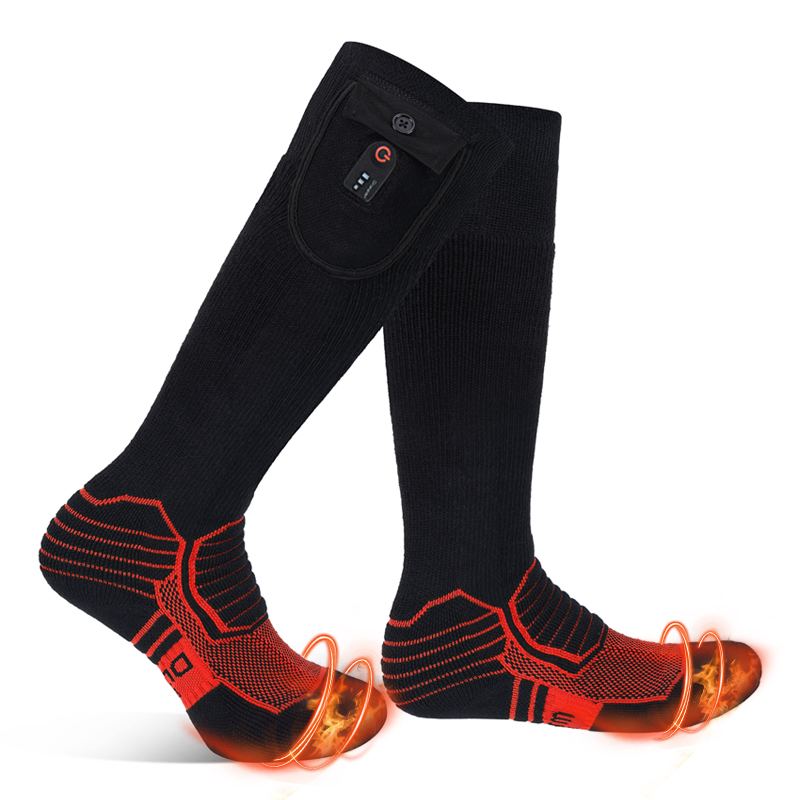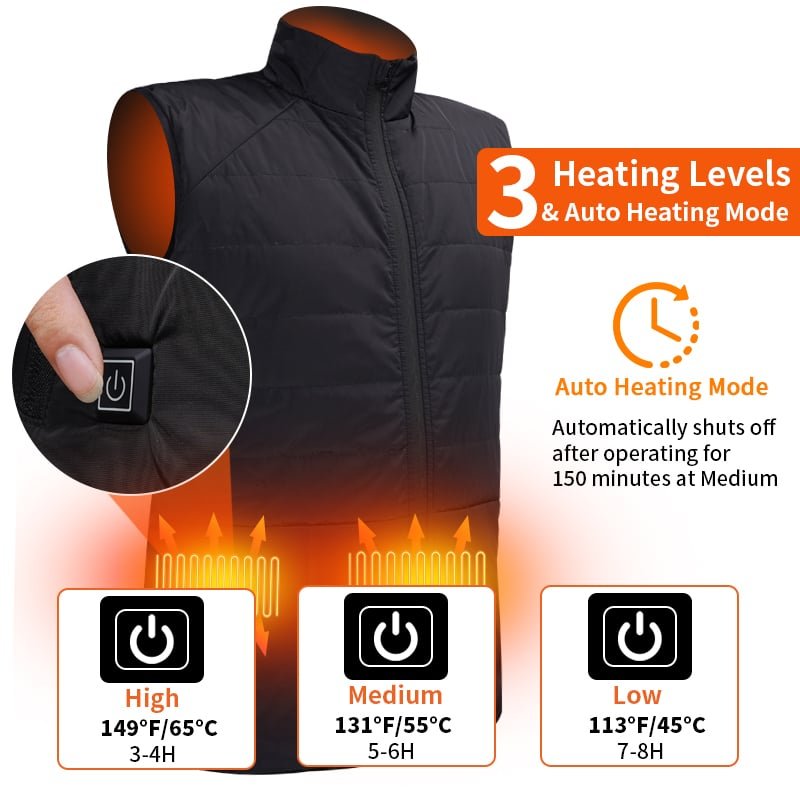
Quick answer: Most heated jackets cycle through three levels with a button on the chest or cuff — Low, Medium and High. Some models add independent zone control, a wireless remote or app control, and a few regulate to a target temperature band. Start on Low or Medium and step down once comfortable; the highest setting is for rapid warm-up and draws the most current.
This guide explains each control mode, where temperatures come from, and what brand owners should specify at the sample stage. For the underlying circuit, see how electric heated clothing works.
Three-Level Button Control
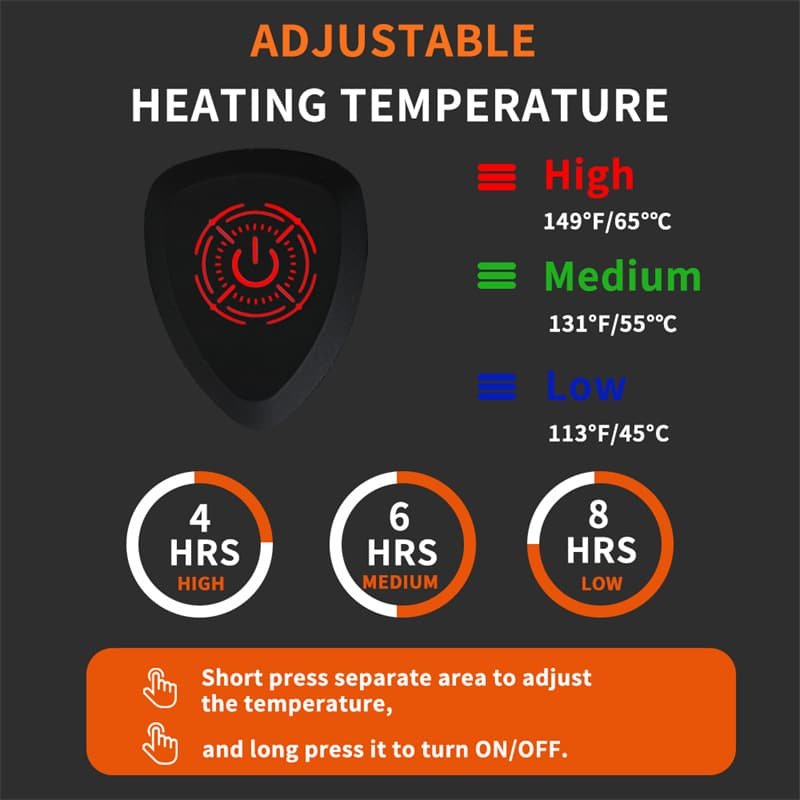
The most common setup is a single button that cycles Low → Medium → High → off, often with an LED colour or blink pattern for each level. It is robust, works with gloves on and needs no phone. The controller regulates power to the elements at each level; it does not usually hold an exact temperature.
Temperatures are specified per model, not per category. On the standard garment platform used across jackets, vests, base layers and heated trousers, three levels run Low 35-40°C, Medium 45-50°C and High 55-60°C. A high-specification jacket using PTC and carbon-fibre elements runs Low 40-45°C, Medium 50-55°C and High 60-65°C. All values are in degrees Celsius — check the specification sheet for your model.
| Platform | Typical jacket use | Charger output |
|---|---|---|
| 7.4V | Most heated jackets, gloves and socks | 8.4V / 1.5A |
| 5V USB power bank | Selected vests and lightweight jackets, 10,000-20,000 mAh | 5V / 2A or 5V / 3A |
| 12V | High-output jacket platforms | 5V / 3A |
| 24V | Industrial and special applications | Custom build on request |
Independent Heating-Zone Control
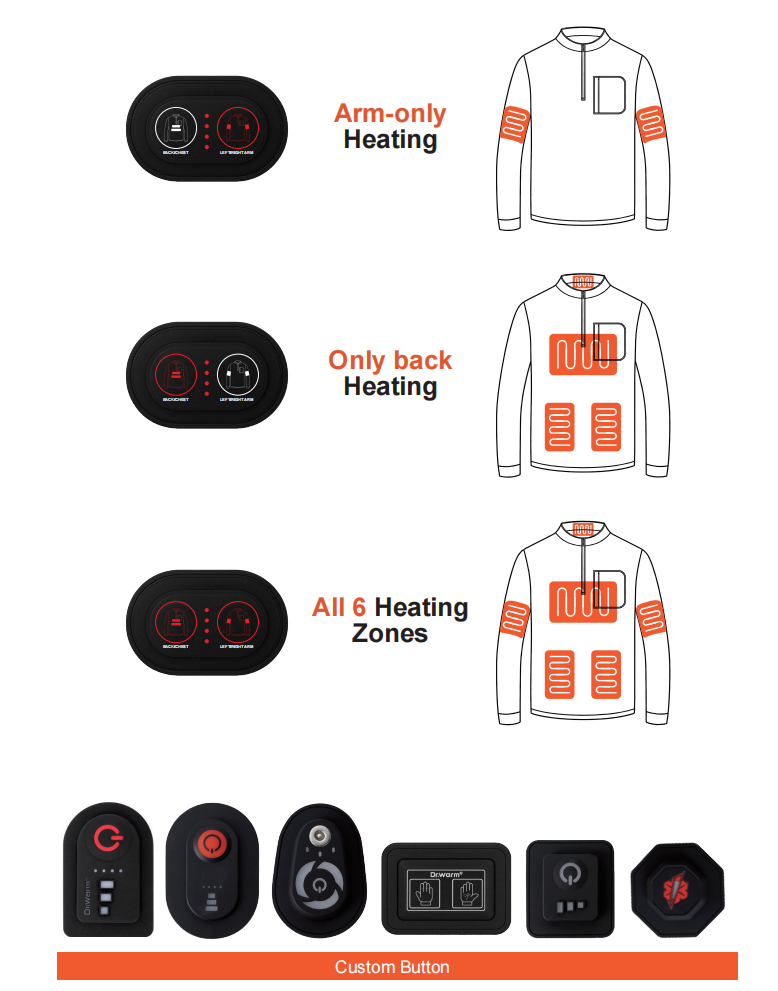
Some jackets divide the elements into channels — for example chest and back separately, or arms separately — with a dual button or a controller that lets the user switch channels off. This is useful for managing runtime: heating only the back on a mild day uses less current than running every zone on High.
Every additional channel adds wiring and controller complexity, so it belongs in the brief rather than being assumed. On a private-label project, confirm the channel map on a physical sample and make sure the manual explains it plainly.
Bluetooth App Control and Remotes
| Control mode | What it offers | Trade-off |
|---|---|---|
| Button on garment | Simple, glove-friendly, no pairing | Fixed levels, no per-zone detail |
| Wireless remote | Change level without opening the outer layer | A separate item to carry and charge |
| Bluetooth app | Fine level selection, battery status, zone toggles on suitable lines | Needs a charged phone; more validation and documentation |
| Automatic regulation | NTC sensing or controller logic holds a target band and cuts out on over-temperature | Model-specific; confirm it is real regulation, not staged power |
App control is available on suitable product lines, but it is not automatically better for B2B buyers: it adds a firmware dependency and a support surface in every market. For workwear and rental fleets, a button is often the more reliable choice.
Which Heat Level Should Users Select?
- Low: all-day background warmth, mild cold, or when layering under a shell.
- Medium: the usual setting for outdoor work, commuting and stop-start activity.
- High: rapid warm-up in severe cold, then step down once comfortable.
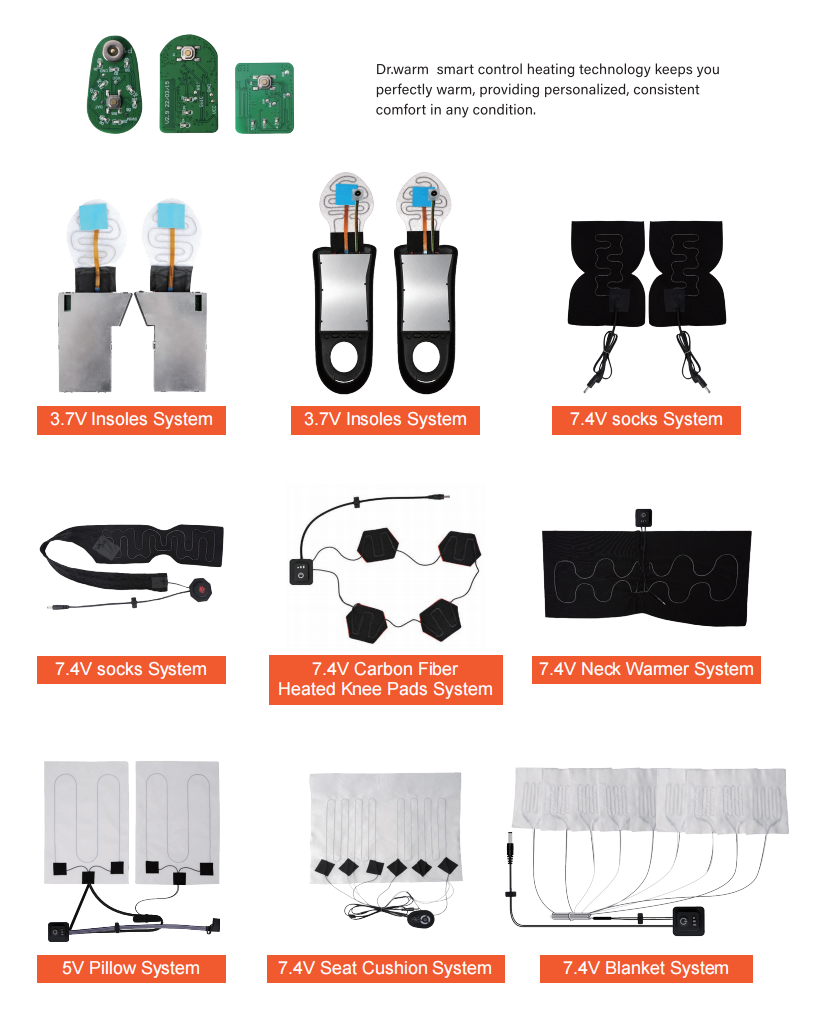
Runtime is not fixed by the level alone. It depends on battery capacity, the number of active zones, the selected heat level and ambient temperature. Standard platforms cover 3.7V, 5V, 7.4V and 12V with 24V available as a custom build; many jackets use 7.4V with an 8.4V / 1.5A charger, some use a 5V USB power bank with 5V / 2A or 5V / 3A, and a high-output 12V jacket is a separate platform. Battery capacity is configured to the order, not fixed. See how long a charge lasts for why a single headline runtime number misleads.
Diagnosis: When the Control Behaves Oddly
If the button does nothing, check the battery charge and that the connector is fully seated; moisture in the port can put the controller into protection mode. If one zone is cold while others heat, that points to a channel or element issue rather than the control mode. If output changes unexpectedly, confirm the charger is the matched one — a wrong charger can cause unstable output. A fuller fault checklist is in jacket troubleshooting.
If a burning odour, a swollen battery, a melted connector or a sudden temperature change appears, stop using the jacket and do not recharge it. Lithium cells can present overheating, fire and burn hazards when damaged or paired with unsuitable charging equipment.
What OEM Buyers Should Specify
For OEM projects the MOQ is 100 pieces, full ODM 500 pieces and a single stock sample is available; sampling takes 7-30 days and OEM production 20-25 days. Specify the number of levels and their temperature bands per model, the channel map, the control method, over-temperature cutoff, connector type and charger pairing. Warranty is 12 months and cells are rated for 500+ cycles.
Buyers commonly request CE, UKCA, UL, FCC, RoHS, Reach, UN38.3, DOE and ISO 9001, plus GB 47372-2026 with CCC on the battery side; see what each covers. Production covers 3 lines in a 6,000 m² main plant plus a separate 2,074 m² electronics assembly workshop, with 8 in-house R&D engineers. Dr. Warm has supplied heated products Since 2013. For fit differences between patterns, see men’s vs women’s heated jackets.

Frequently Asked Questions
How do I adjust the heat on a heated jacket?
Most jackets use a button on the chest or cuff: press to cycle through Low, Medium and High, and hold to switch off. Some models offer independent zone control, a wireless remote or app-based control. Check the manual for your exact model, since button behaviour differs.
Which heat level should I use?
Start on Low or Medium and step down once comfortable. The highest setting is for rapid warm-up in severe cold, not continuous all-day use; it also draws more current and shortens runtime.
Do heated jackets have automatic temperature control?
Some platforms use NTC sensing or controller logic to hold a target band and cut out on over-temperature, but behaviour is model-specific. Ask whether the controller regulates to a set point or simply switches between fixed power levels.
What should OEM buyers specify about the controller?
The number of levels and their temperature bands per model, independent zone channels, button or remote or app control, over-temperature cutoff, and the connector and charger pairing. Confirm all of it on a physical sample.
Specifying a controller for your line? Send us your market and target price band and we will map the available control options.