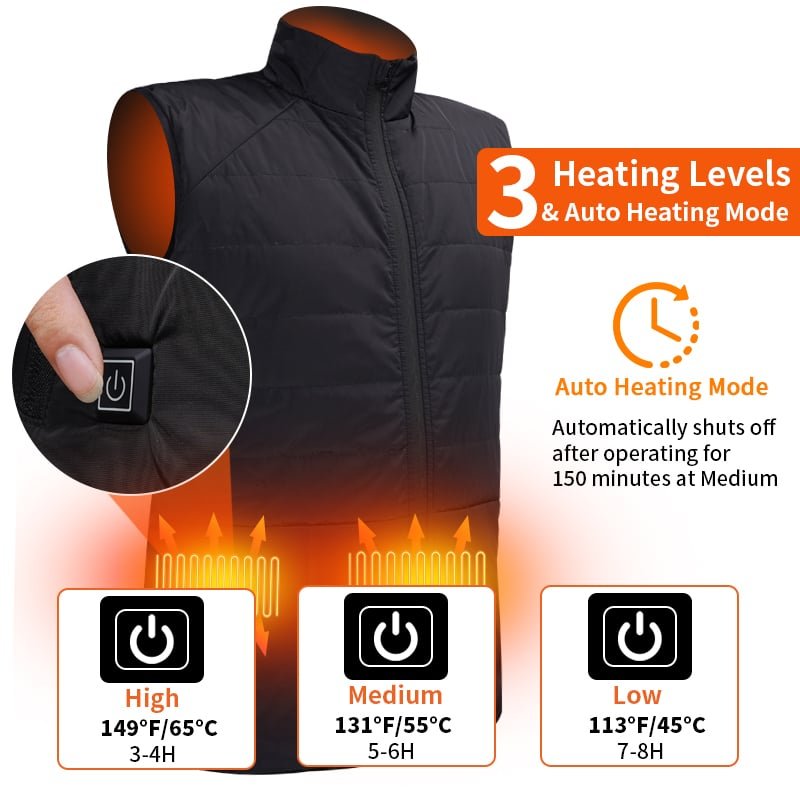

Quick answer: A bulk heated vest order can be customised across four layers — garment and fabric, heating zones, battery and control, and private label. MOQ is 100 pieces for OEM, 500 pieces for full ODM and 1 piece for a stock sample. Sampling takes 7-30 days and OEM production 20-25 days. The decisions that actually shape the quote are zone count, voltage platform and compliance documentation, not the logo.
This guide is written for wholesalers and brand owners building a winter vest line. For the overall development sequence see our OEM and ODM services and the factory where both the garment and the electronics are produced.
Garment and Fabric Customisation
| Layer | Options | Effect on the project |
|---|---|---|
| Shell and fit | Fleece vest, softshell, quilted or puffer, lightweight liner; men’s, women’s or unisex patterns | Pattern work and size grading; adds sampling time |
| Fabric and trims | Anti-pill fleece, windproof membrane, reflective panels, branded zippers, pocket layout | Material minimums; IPX4 standard, IPX5 optional |
| Heating zones | Chest, abdomen, upper or lower back, collar; commonly four zones | Element layout needs electrical validation |
| Power and control | 5V USB power bank or 7.4V; button, remote or app control; connector and charger type | Determines runtime and certification path |
| Private label | Logos, woven and care labels, zipper pulls, manuals, retail boxes, barcode labels | Artwork approval only; fastest change |
A vest is the most layer-friendly heated garment, so fit deserves more attention than it gets. It should sit close enough to transfer heat to the core, but loose enough to be worn over a base layer and under a shell without bunching at the waist. Confirm the size run against your market’s body measurements, not just a generic S–XL chart.

Heating-Zone Customisation
A common vest layout uses four elements across the chest and abdomen; some programmes add an upper-back or collar zone. More zones mean more current draw and more wiring routes through a garment that folds at the waist. The zone drawing should be fixed before tooling, because moving a single element afterwards changes the harness length and the controller mapping.
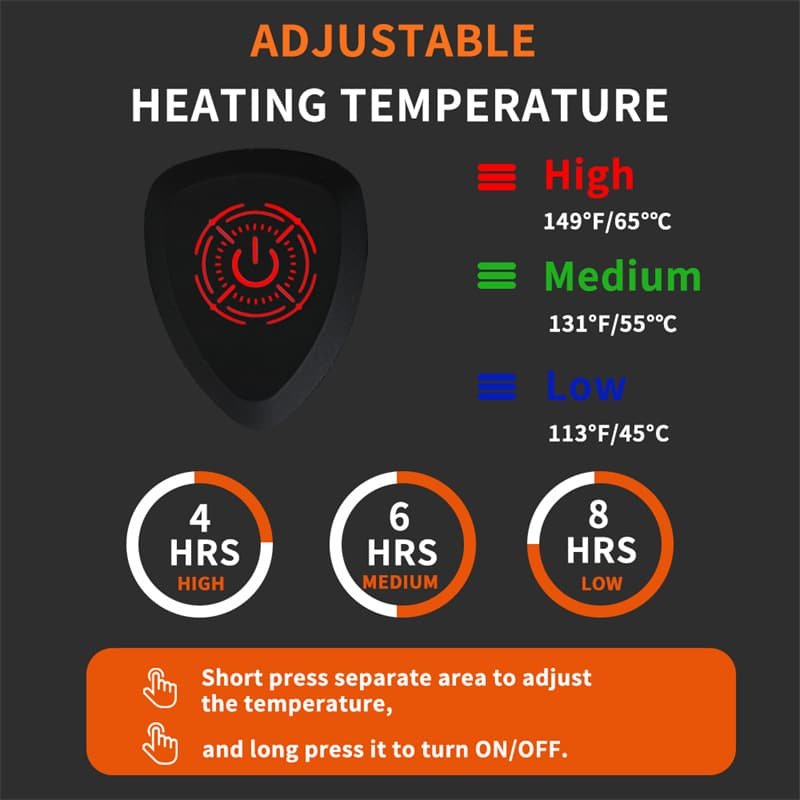
Temperatures are specified per model, not per category. On the standard garment platform used across vests, jackets, base layers and heated trousers, three levels run Low 35-40°C, Medium 45-50°C and High 55-60°C. All values are in degrees Celsius; a brief that asks for “the hottest vest” will get a slower, less useful answer than one naming the intended use case.

Battery and Control Options
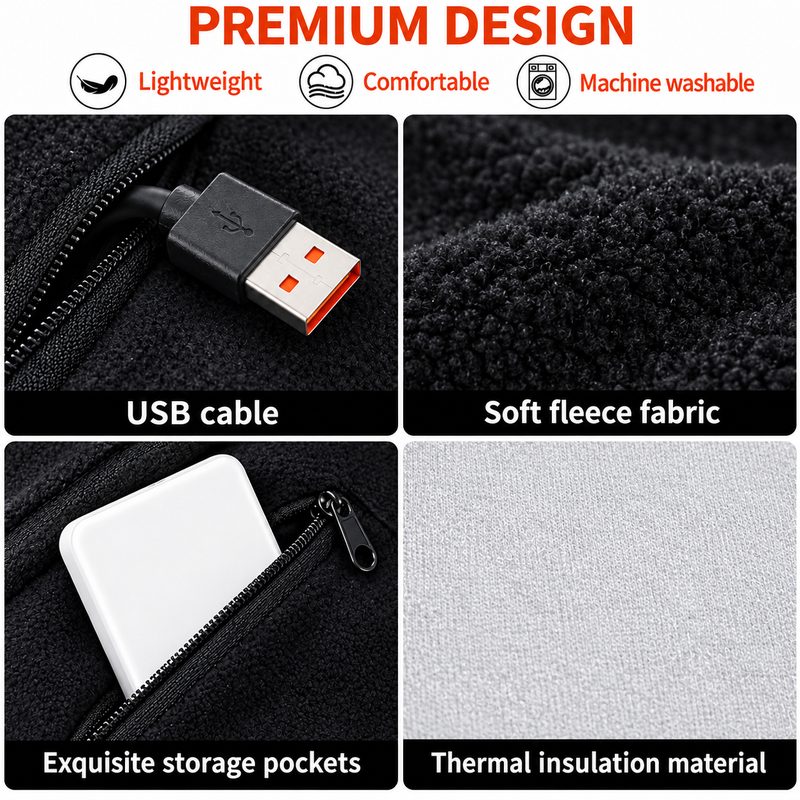
Many vests run on a 5V USB power-bank system, typically with a 5V / 2A charger or 5V / 3A for larger packs; other garment platforms use 7.4V with an 8.4V / 1.5A charger. Standard platforms cover 3.7V, 5V, 7.4V and 12V, with 24V available as a custom build. Battery capacity is configured to the order rather than fixed — 5V packs span 10,000–20,000 mAh for jackets and vests, while 7.4V packs are smaller.
Controller choices are button, wireless remote or app-based, with connector options covering USB, DC, Micro, Type-C and magnetic charging. Charging time is model-specific, so avoid quoting a single number across a range. Warranty is 12 months and cells are rated for 500+ cycles. For how the element, controller and wiring interact, see our heating system guide.
| Platform | Common vest use | Charger output |
|---|---|---|
| 5V USB power bank | Fleece and softshell vests, 10,000-20,000 mAh packs | 5V / 2A or 5V / 3A |
| 7.4V | Garment platforms using compact dedicated packs | 8.4V / 1.5A |
| 12V | High-output jacket platforms, not typical for vests | 5V / 3A |
| 24V | Industrial and special applications | Custom build on request |
Private-Label and Documentation
- Printed or embroidered logos, woven and care labels, custom zipper pulls and battery branding
- Instruction manuals and washing guidance in your market’s languages
- Retail boxes, carrying bags and barcode labels matched to your channel
- CE, UKCA, UL, FCC, RoHS, Reach, UN38.3, DOE and ISO 9001, plus GB 47372-2026 with CCC on the battery
- UN38.3 test summary and SDS as shipping documents — the SDS is not a certification
Compliance paperwork should be agreed at the brief stage, not after production. The conformity documentation is held by Dongguan S-KING Limited; production is carried out by Dongguan Ditewang Intelligent Technology Co., Ltd. See what each certification covers before specifying them in a listing.
OEM and ODM Development Path
A typical project runs: brief and target price → engineering proposal and zone drawing → sample → sample testing and approval → bulk production → inspection → branded packaging. Sampling takes 7-30 days, OEM production 20-25 days, full ODM development 50-60 days, and standard bulk production orders are completed within 45 days. The most common delay is changing artwork or the zone drawing after sample approval.
Production covers 3 lines in a 6,000 m² main plant plus a separate 2,074 m² electronics assembly workshop, with a team of 56 and 8 in-house R&D engineers and annual capacity over 1,000,000 pieces. Dr. Warm has supplied heated products Since 2013. For selection criteria on the retail side, see how to choose a heated vest and heated vests vs regular thermal vests.
Frequently Asked Questions
What can be customised on a bulk heated vest order?
The garment shell and fabric, the number and position of heating zones, the battery and control platform, and the full private-label layer including logos, labels, manuals and retail boxes. OEM branding starts at 100 pieces; full ODM development starts at 500 pieces.
What is the MOQ for a custom heated vest?
100 pieces for OEM, 500 pieces for full ODM development and 1 piece for a stock sample. Sampling takes 7-30 days, OEM production 20-25 days and full ODM development 50-60 days.
Can you match my brand colours and logo?
Yes. Colourways, printed or embroidered logos, woven labels, zipper pulls, battery branding, instruction manuals and retail packaging can all be matched. Artwork is approved against a physical sample.
Which battery platform do heated vests use?
Many vests use a 5V USB power-bank system with a 5V / 2A or 5V / 3A charger, while other garment platforms use 7.4V with an 8.4V / 1.5A charger. Capacity is configured to the order, not fixed, and runtime depends on zone count, heat level and ambient temperature.
Building a vest programme? Send your market, quantity and target price band and we will map the closest existing platform before quoting.