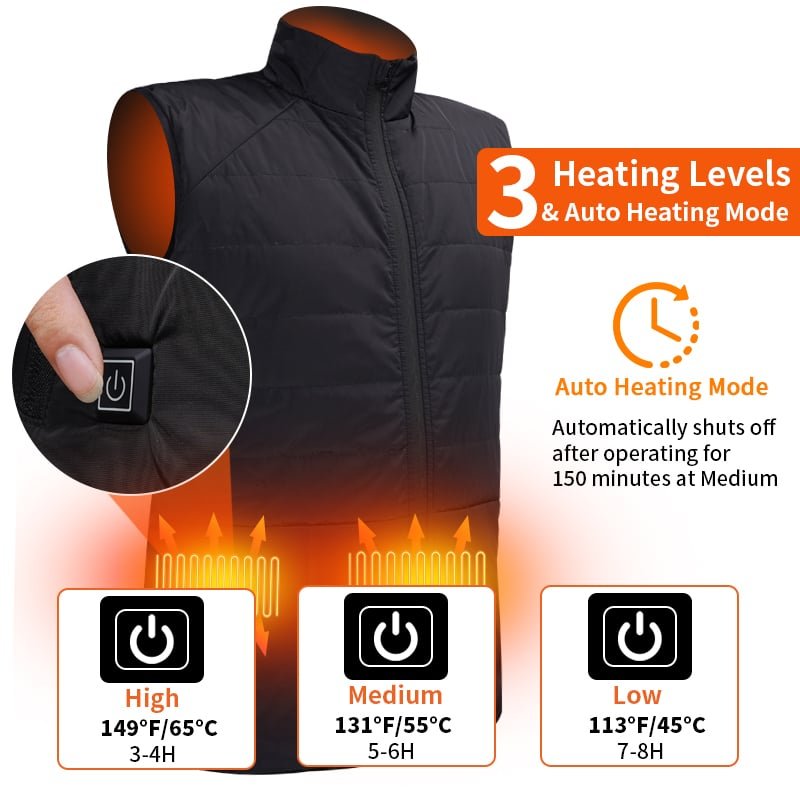

Short answer: decide which layer the vest is for before you compare anything else. A vest worn against a base layer, a vest worn between a shirt and a shell, and a vest worn as the outer layer are three different products with different fabric weights, different armhole sizes and different battery positions. Heating zone count, battery capacity and fabric only make sense once the layer position is fixed.
This is the one selection question the usual feature lists skip. A heated vest is the only garment in the range designed to be worn at three different depths, and the gap between the same vest worn as a base layer and worn under a shell is larger than the gap between two competing models. Get the layer wrong and no specification will rescue the product.
Three positions, one garment

| Structure | Usual zones | Layer it is designed for | Main constraint |
|---|---|---|---|
| Thin bonded vest | 2 to 4 | Against a base layer or a shirt | No hard points — a zip pull or button pressed into the chest is felt within minutes |
| Fleece mid layer | 4, front and back | Between a shirt and a shell | Armhole size, and a battery pocket the shell does not cover |
| Quilted or padded vest | 4 to 6 | Mid layer in deep cold | Bulk — the outer shell has to be sized up, and the range has to say so |
| Softshell outer vest | 4 | Outer layer | Wind resistance matters more than watts; the armhole is now open to the weather |
| Workwear vest | 4 to 6 | Outer layer over a shirt | Harness and tool-belt contact: panels and wiring have to avoid the strap line |
1. The armhole is the vest’s biggest heat leak
A jacket traps air in the sleeves. A vest does not, which means its two armholes and its neck opening are unsealed edges — and warmth leaves through an edge far faster than through a fabric. This is the structural fact that should drive every layout decision on a sleeveless garment, and it is the reason a vest that feels excellent indoors can feel ordinary on a windy street.
Three practical consequences. Panels belong on the trunk, where the heat stays: chest, abdomen, upper back and lower back. Shoulder panels are mostly decorative on a vest, because the shoulder is at the edge of the opening. And a heated collar is not a gimmick on a sleeveless product — it is the cheapest way to close one of the three leaks, which is why it appears on hunting and workwear models rather than on commuting ones.
It also changes what “four zones” means. Four small panels on the trunk will hold warmth better than six panels spread up to the shoulders, because the six-zone version spends power heating the part of the garment closest to the escape route. Zone count is a layout description, not a quality measure.
2. Front and back have to switch separately
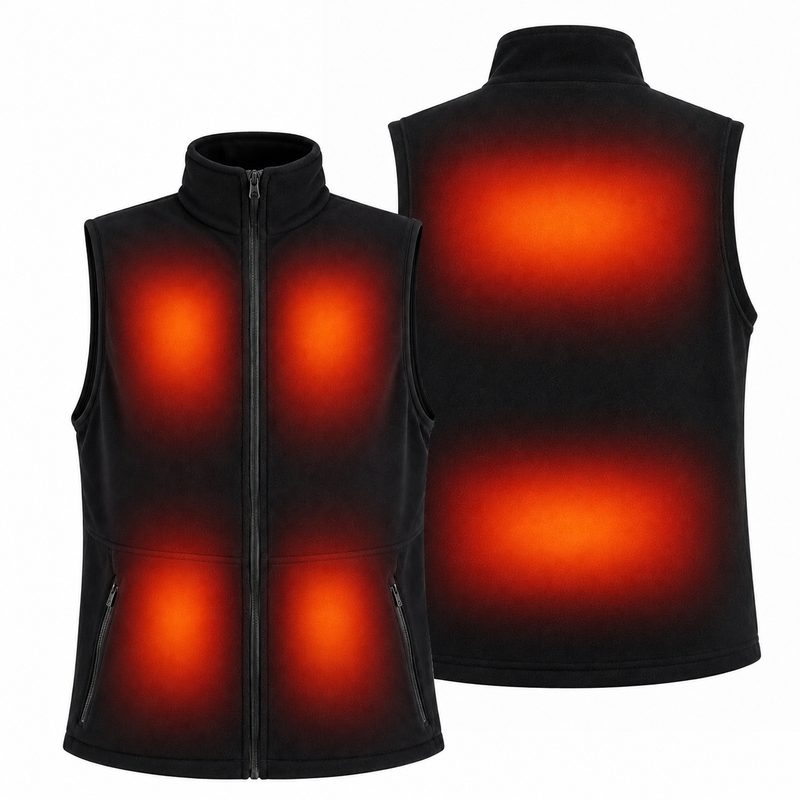
On a vest, the front and the back are not two halves of one heating job. The front faces the wind and is usually open to the air above whatever the wearer is carrying. The back is often pressed against something: a chair, a car seat, a backpack, a harness, a tree stand. Those are opposite requirements, and a single switch forces the wearer to choose one of them.
That is why the second control channel is the specification worth paying for on a vest. With independent front and back control, a commuter can run the front on medium and switch the back off when seated; a rider can do the reverse; a worker with a harness can drop the back to low and still keep the chest warm. Without it, the vest either overheats the front or underheats the back, and the customer reports it as a comfort problem rather than a design one — which is the pattern behind most of the common heated vest complaints.
The buying question is therefore narrow and answerable: can the front and the back be set to different levels, or switched off independently? If a quotation cannot answer that in one line, the controller is a single-channel design.
3. Fabric is a weight and packing decision before it is a comfort one
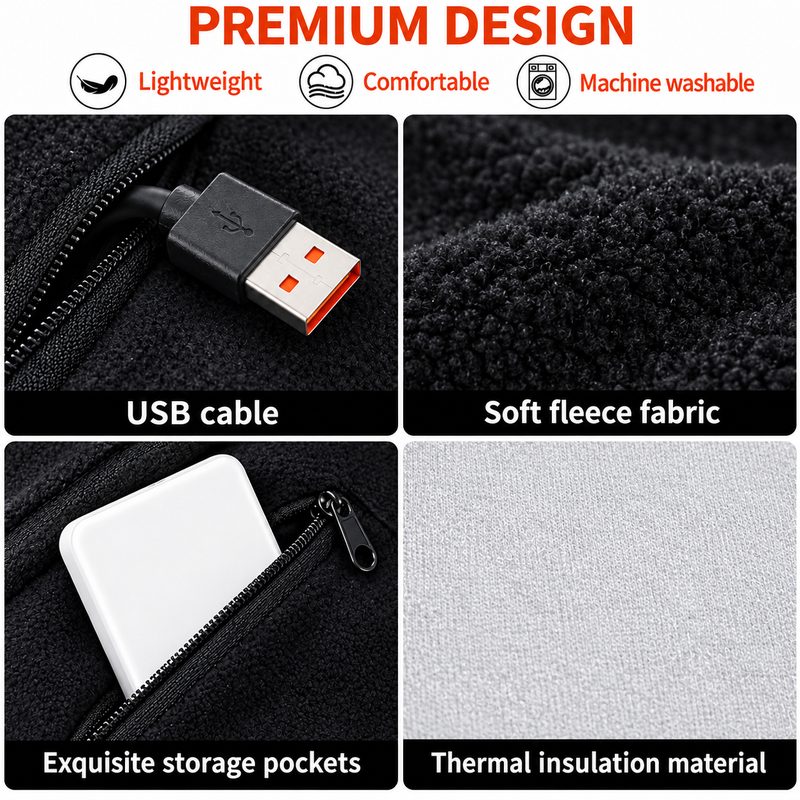
Every fabric option on a vest trades weight against wind resistance and packability. Fleece is light, breathable, machine washable with the pack removed, and almost transparent to wind — which makes it a mid layer and only a mid layer. Softshell blocks wind and costs weight. Quilted and padded shells insulate best and pack worst. Workwear canvas survives abrasion and feels stiff for the first week.
Two numbers make the choice comparable, and both are usually missing from a quotation: the fabric weight in grams per square metre, and the packed volume of the garment. They matter because a vest is judged in a suitcase as often as on a body — a padded vest that will not compress is a different product from a fleece one even if the heating system is identical. Ask for both, plus whether the garment is machine washable with the pack removed and what the care label actually states.
Graphene and carbon-fibre heating systems sit on top of that decision rather than replacing it: they change how evenly the panel heats, not how much of the heat the fabric keeps. Our graphene comparison covers the difference in heating behaviour.
4. Pick the voltage platform for the range, not for one vest
A vest is the easiest product in the range to standardise, because its pack sits in a pocket rather than on a joint, and the same platform can usually serve the jackets sold beside it. That makes the platform decision a catalogue decision: one voltage means one charger, one spare-pack accessory and one set of retail SKUs instead of four.
| Platform | Standard capacities | Energy | Charger | What it suits |
|---|---|---|---|---|
| 3.7V | 2,200 / 2,500 / 3,200 / 5,000mAh | 8.1 to 18.5Wh | 5V 2A | Thin vests and short commutes; the lightest pack in the range |
| 5V USB | 10,000 / 20,000mAh | 50 to 100Wh | 5V 2A or 3A | Long outdoor sessions, and a pack the customer can also use as a power bank |
| 7.4V | 2,200 / 3,000 / 4,000mAh | 16.3 to 28.1Wh | 8.4V 1.5A | The platform most easily shared with the jackets and gloves sold beside it |
| 12V | 5,000mAh | 60Wh | 5V 3A | High-power, many-zone workwear and extreme cold |
Capacity only becomes runtime when it is divided by the draw of the circuit, and a vest with more zones draws more at the same setting — the method is worked through in our vest runtime analysis. What the platform table settles is the part buyers usually leave until too late: whether a spare pack bought for the vest will also serve the jacket.
5. Fit has two constraints, not one
A vest is worn over something and under something else, and both layers constrain the pattern. Inside, the chest and shoulder measurements decide whether the wearer can raise an arm without the hem lifting; outside, the armhole and the body width decide whether a shell will close over it without compressing the panels against the wearer.
That is why grading a vest is not a matter of scaling a pattern up. On a larger size the panels have to move outward and the pocket has to move with them, or the heating ends up under the arm rather than over the chest. A range that keeps panel dimensions constant and only enlarges the shell produces exactly the fit complaint described in our slim versus loose fit comparison. Ask how panel placement is graded per size, not only what sizes exist.
6. Test the sample in the layers it will be sold for
- Wear it in three layers, outdoors, for half an hour. Base layer, vest, shell. A vest that passes indoors will often fail at the armhole in wind, and that is not visible on a hanger.
- Reach for the cable exit and the pocket with the shell on. If the wearer has to open the outer layer to reach the switch or the pack, the layering was not designed — it was permitted.
- Load the biggest pack the range offers. A pocket sized for a small pack will bulge with a larger one, and the bulge shows through a shell.
- Compress the garment. Fold it as it would travel and see what it costs in a case. Padded vests lose this test more often than they lose the warmth test.
- Check the panel edges by hand. Run a palm across the chest and the upper back: any ridge under the lining will be felt after an hour, whatever the fabric specification says.
Dr. Warm builds rechargeable heated vests for brands, distributors and retailers across 3.7V, 5V, 7.4V and 12V platforms, with panel layout, front and back control channels, fabric weight, pocket position, size grading and packaging specified as one product rather than five purchases. The compliance file behind a vest order covers CE, UKCA, UL, FCC, RoHS, Reach, UN38.3, DOE, ISO 9001 and GB 47372-2026 with CCC. If you are choosing between a thin layer and a padded one for the same range, send the market, the layer position and the quantity, and we will quote both through our OEM and ODM service. The finished range is on our heated vest category page, and the broader comparison of what to specify sits in the full heated vest buying guide.
Frequently Asked Questions
Should a heated vest be worn over or under a jacket?
Under it, in almost every case. The vest generates heat and the shell stops that heat being taken away by wind, so the two work as one system. Wearing the vest outside a shell only works when the vest itself is wind-resistant, which means a different fabric and a different product. The rule of thumb: the more wind and the longer the exposure, the more the vest wants a shell over it.
How many heating zones does a heated vest need?
Trunk coverage matters more than the total count. Four panels across the chest and abdomen with a separate back channel will outperform six panels spread up to the shoulders, because the shoulder sits beside the armhole where warmth escapes. For commuting and workwear, giving the front and the back their own control is a bigger upgrade than adding two more zones.
Can a heated vest share a battery with a heated jacket?
Usually yes, provided both use the same voltage platform and the same connector, which is the main reason to standardise the platform across a range rather than choosing it per product. The pack capacity and the controller have to match the garment, not just the plug. Confirm the watt-hour rating and the connector type in writing before assuming a spare will serve both.
Is a padded heated vest too bulky to wear under a shell?
Often, yes, and the fix is sizing rather than a thinner vest. A padded vest under a shell compresses the panels against the body, which concentrates heat and restricts movement, so the shell usually needs to be one size up and the range has to say so. A fleece mid layer solves the same problem with less bulk, at the cost of wind resistance.