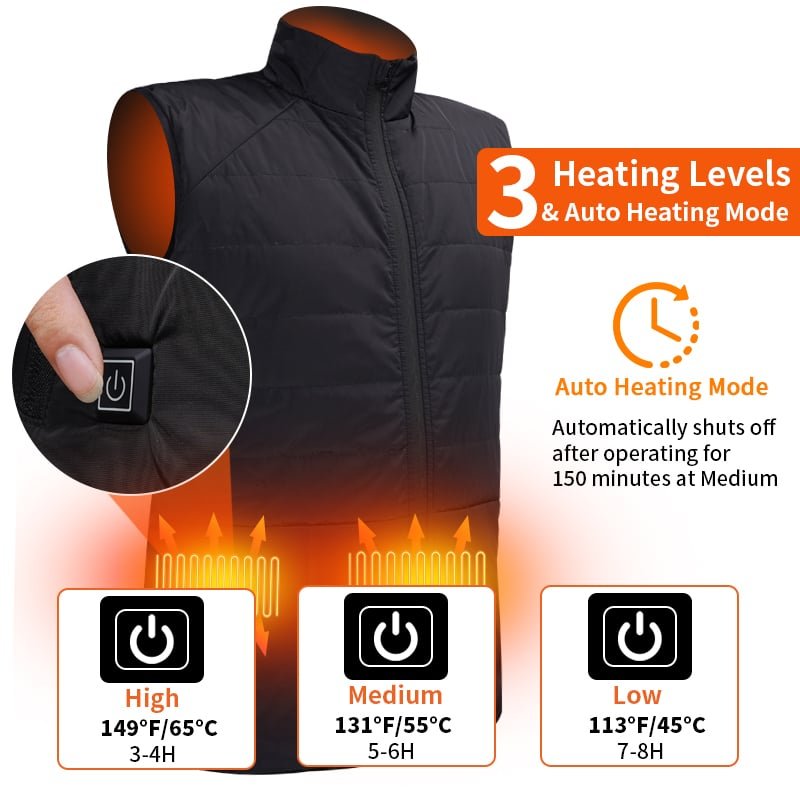
Quick answer: Yes — a heated vest is built to be worn under a jacket. It warms the core while the outer shell handles wind and snow, leaving the arms free. Fit it close but not tight: a base layer underneath, the vest in the middle, a shell over it. For skiing and winter cycling, check that the battery pocket does not bounce and that the control button is reachable with gloves on.
This guide covers why layering works, how to get the fit right, and the two activities where it matters most. For a wider comparison of the two garment types see heated jackets vs heated vests.
Why Layer a Heated Vest Under a Jacket?
| Benefit | How it works |
|---|---|
| Core warmth with less bulk | Heat is delivered at the chest and abdomen, close to the body, instead of heating a thick outer garment |
| Freer arm movement | No sleeves or shoulder insulation — useful for cycling, climbing and pole work |
| Ventilation control | Open the outer shell to dump heat without switching off the vest |
| One vest, several outfits | Works as a base, mid or under-shell layer across a season |
| Lighter pack | A vest packs small and can be carried as a spare layer |
Warmth at the core is mostly about contact, fit and trapped air, not about how much of the body the heated garment covers. A snug vest under a windproof shell can feel as warm at the torso as a bulky jacket, because the shell stops the heat from being stripped away by wind.

What Fit Works Best?
- Close, not compressive: the vest should touch the base layer without squeezing the chest.
- No bunching at the waist: pull the outer shell on and bend forward — the vest should not roll up.
- Shoulders free: lift both arms; the shell should not drag the vest upward.
- Battery pocket stable: it should sit flat and not bounce when you move.
- Controls reachable: on some shells the outer zip presses the button — test with gloves on.
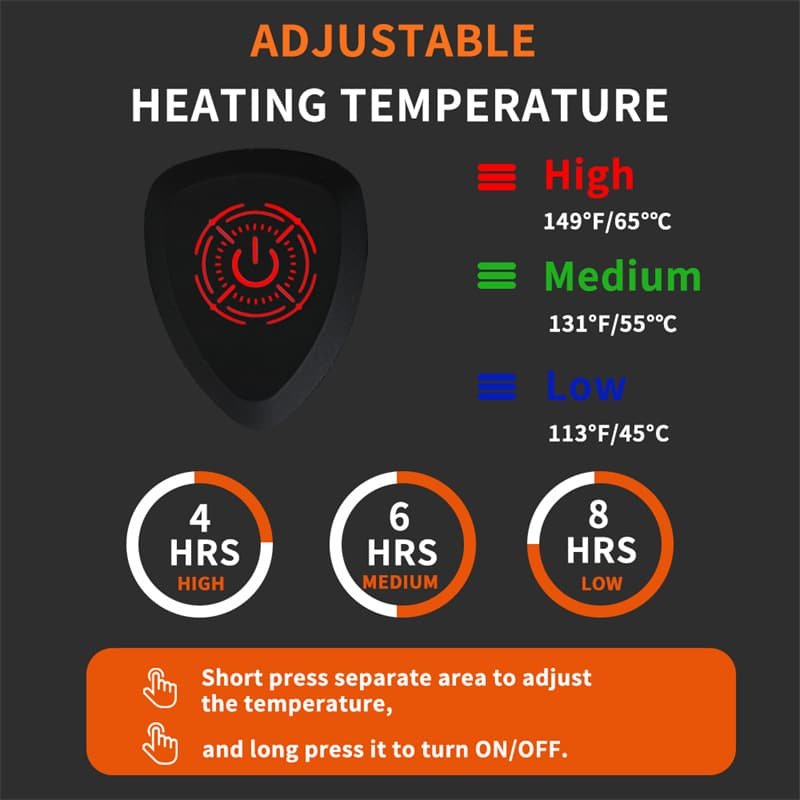
Temperatures are specified per model, not per category. On the standard garment platform used across vests, jackets, base layers and heated trousers, three levels run Low 35-40°C, Medium 45-50°C and High 55-60°C, in degrees Celsius. Start on Low or Medium when layering: the outer shell holds heat in, so the highest setting is often unnecessary.
Heated Vests for Skiing
Skiing alternates high exertion with static chairlift time. A vest under a shell handles both: unzip the shell on the descent, close it on the lift, and adjust the heat level rather than removing a layer. Look for a secure battery pocket, a protected connector, IPX4 water resistance (IPX5 optional) and a control button you can operate with gloves.
Keep the connector dry. Snow melts into a collar and can work down toward the battery pocket; after a wet day, let the vest and port area dry fully before charging. IPX4 and IPX5 ratings do not cover connecting power while the port is wet.
Heated Vests for Winter Cycling
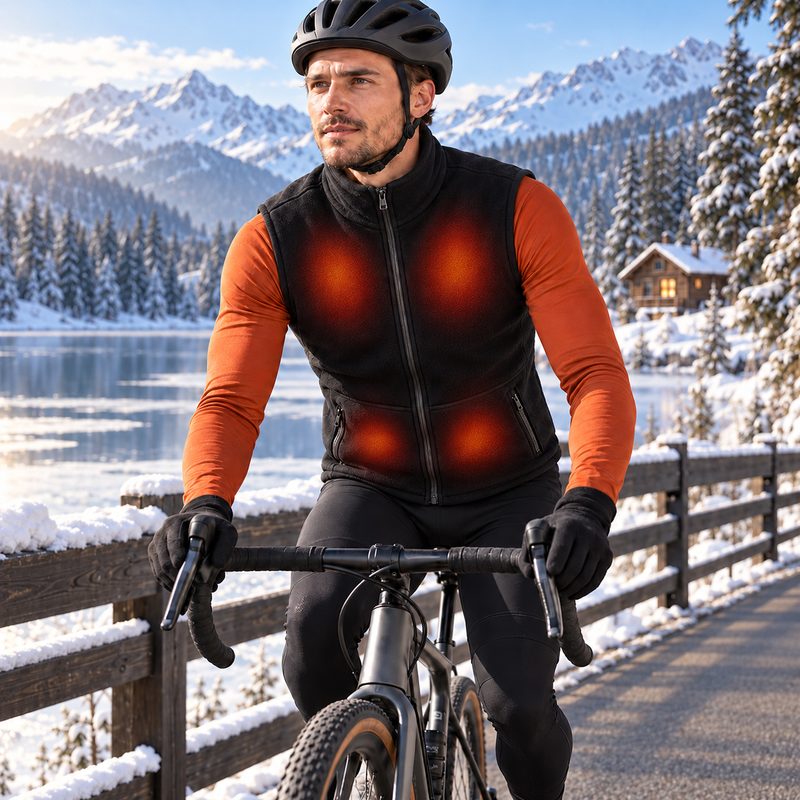
Cycling is the clearest case for a vest: the arms need full range of motion, wind chill is high, and effort varies. A thin, close vest under a windproof shell keeps the core warm without the shoulder bulk of a jacket. Keep the fit slim so there is no fabric flapping at speed, and check that the battery lead does not rub against the saddle or hip.
| Decision | Skiing | Winter cycling |
|---|---|---|
| Outer layer | Insulated, weatherproof shell | Light windproof shell |
| Heat level | Low/Medium on the descent, up on the lift | Low/Medium; exertion adds warmth |
| Battery position | Secure pocket, no bounce on turns | Flat pocket, lead clear of the hip |
| Moisture risk | Snow melt at the collar | Sweat plus road spray |
Many vests use a 5V USB power-bank system with a 5V / 2A or 5V / 3A charger; other garment platforms use 7.4V with an 8.4V / 1.5A charger. Standard platforms are 3.7V, 5V, 7.4V and 12V, with 24V available as a custom build. Battery capacity is configured to the order, not fixed, so runtime depends on capacity, active zone count, heat level and ambient temperature. For more, see how to select a heated vest.
What This Means for a Brand Range
For OEM projects the MOQ is 100 pieces, full ODM 500 pieces and a single stock sample is available. Sampling takes 7-30 days and OEM production 20-25 days. Warranty is 12 months, with cells rated for 500+ cycles.
Production covers 3 lines in a 6,000 m² main plant plus a separate 2,074 m² electronics assembly workshop, with a team of 56 and 8 in-house R&D engineers. Dr. Warm has supplied heated products Since 2013. Fit grading and battery-pocket placement are the two sample-stage decisions that most affect how the vest layers — see our OEM/ODM guide and the factory.
Frequently Asked Questions
Can a heated vest be worn under a jacket?
Yes. A heated vest is designed as a core-warming layer that sits under a shell. It should fit close enough to transfer heat but leave room for a base layer underneath and an outer shell over it, without bunching at the waist or restricting shoulder movement.
How tight should the vest fit for layering?
Close-fitting but not compressive. You should be able to zip the outer jacket without pulling the vest fabric taut, and to lift your arms freely. If the vest shifts or bunches when you bend, the size grade needs adjusting.
What should I look for in a heated vest for skiing?
A slim profile at the shoulders, a secure battery pocket that does not bounce, a protected connector, IPX4 or IPX5 water resistance, and controls reachable with gloves on. Check that the outer shell does not press the control button.
Does layering change runtime?
Layering does not change capacity, but a well-fitted outer shell traps warmth so a lower heat setting is often enough. Runtime depends on battery capacity, active zone count, heat level and ambient temperature.
Building a layering range? Send us your activity and price band and we will map the closest vest platform before quoting.