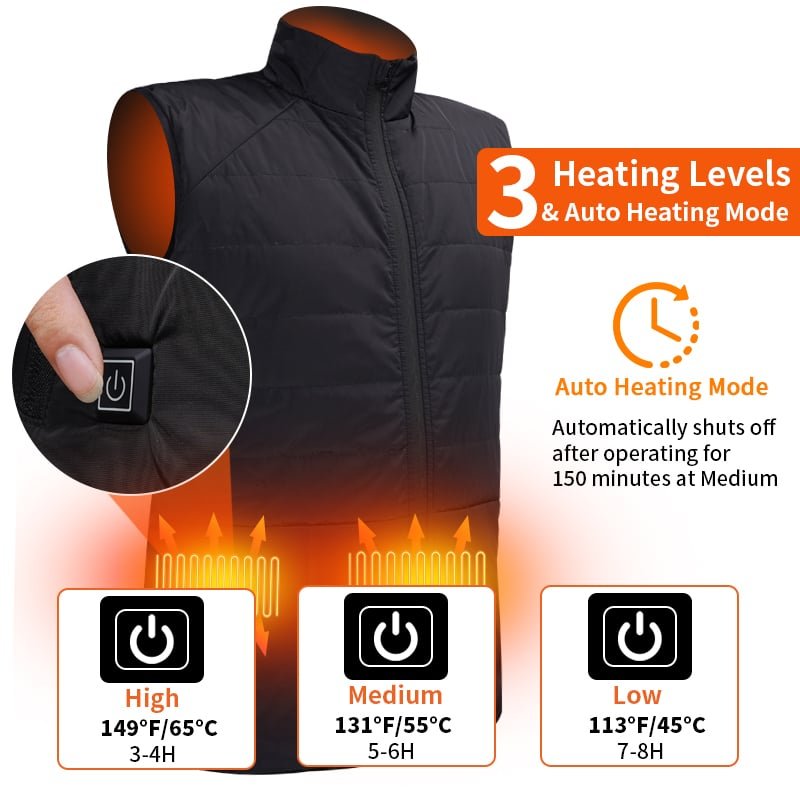
Short answer: the features worth checking before you place an order are not the ones on the marketing page. They are the wire inside the finger, the heating layout you are actually buying, where the pack hangs, how the cuff closes, what the button can be pressed with, whether left and right are matched, and what the factory measured before packing. All seven can be verified on a sample in an afternoon, and none appears on a specification sheet unless the buyer asks.
Most heated glove guides answer a different question: which glove for skiing, which for riding, which for work. This one is for the buyer comparing two quotes for a glove that does not exist yet — a brand, a distributor or a private-label retailer who needs to know which claims are structural and which are adjectives.
1. The glove is the only heated product that bends
Socks, insoles, vests and jackets put their heating elements on a surface that stays roughly flat. It flexes when the wearer sits or layers up, but the element itself is rarely folded along the same line twice. A glove is different: every knuckle is a hinge, and the element runs straight across it.
Put a number on that as arithmetic rather than as a test result. Four hours of continuous wear at ten finger movements a minute is 2,400 flexes a day, and a hundred-day winter is roughly 240,000. That is the load the element has to survive before the second season, and it is why a glove fails in the finger long before it fails anywhere else.
- Alloy heating wire. Cheap, flexible in routing, and it tolerates pulling. Its weak point is exactly the knuckle, where repeated folding concentrates stress on one short section.
- Carbon fibre tow. The best fatigue behaviour of the three and the fastest to reach working temperature. Its weakness is consistency — a small difference in length or tow count changes resistance, so two fingers on the same glove can run at different temperatures.
- Etched metal foil. The most even surface heat and the neatest laminate, which makes it a good choice across the flat back of the hand. Folded repeatedly over a knuckle it work-hardens and cracks, so it belongs on the hand, not on the finger.
So the question to put to a supplier is not “wire or carbon” but “what flex test did this element pass, and how much resistance drift is allowed afterwards”. A number and a tolerance turn a claim into a specification. Without them, element type is a preference. Our breakdown of how heating elements work in heated gloves covers the construction in more detail.
2. Heating layout: what “palm and finger” actually means
Almost every glove quotation says something like “heating area: palm and fingers”. In production that sentence covers at least five different builds, and they do not cost the same or feel the same.
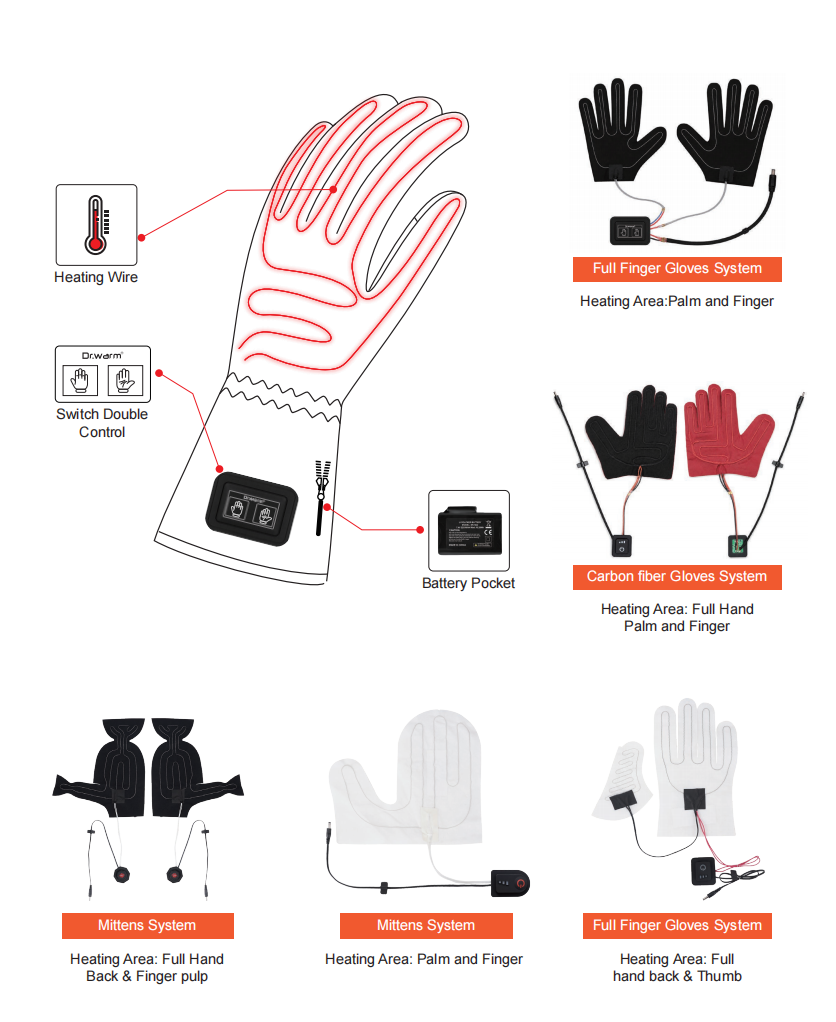
| System | Heating area | What it solves | What it costs |
|---|---|---|---|
| Full finger, palm and finger | Palm plus all five fingers | Hands that feel the cold first at the fingertips | Longest element run, highest flex exposure and draw |
| Carbon fibre, full hand | Back of hand, palm and fingers | Even warmth across the whole hand | Highest material cost, usually dual switch control |
| Full finger, back and thumb | Back of hand and thumb, no palm | Riding and grip work, where the palm is on a bar | Palm stays cold — right on a handlebar, wrong on a ski pole |
| Mitten, back and finger pulp | Back of hand plus finger pulp | Deep cold where dexterity is not needed | No individual finger control, no usable touchscreen |
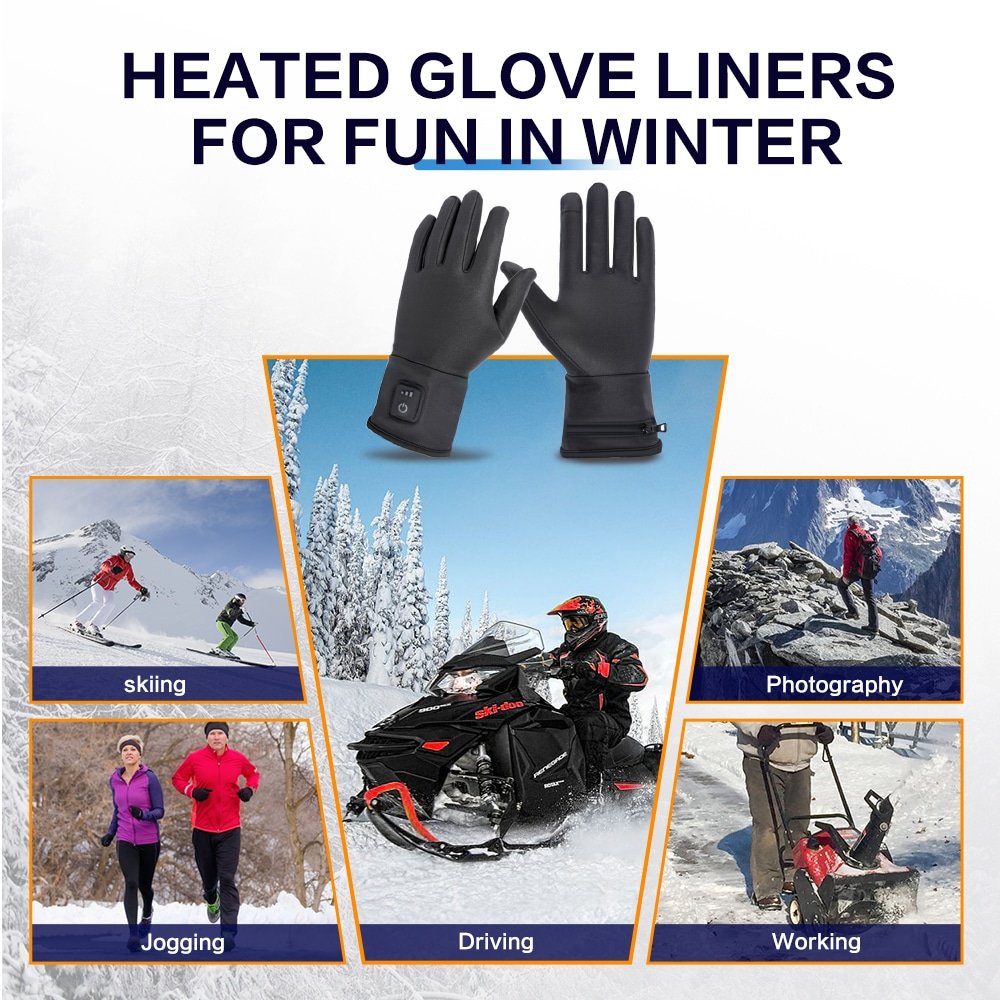
| Liner | Back of hand and fingers, thin build | Wearing inside a shell the customer already owns | No weather protection, and fit problems if the shell is tight |
Two consequences follow. Coverage and runtime are the same decision: the same pack runs roughly twice as long on a glove that heats only the back of the hand as on one that heats the back, every finger and the palm, so a longer runtime claim is often a description of a smaller heated area — the arithmetic is in our glove runtime breakdown. And the cheapest way to look identical in a photograph is to heat only the back of the hand, because the outside looks the same either way. Turn the sample palm-up and look for traces and a bonded panel before accepting a quote.
Mittens deserve a separate decision rather than a size variant: warmer per watt, unusable for anything that needs a fingertip. Which is why our gloves versus mittens comparison treats them as two products rather than two sizes.
3. Where the pack hangs decides comfort before capacity does
On every other heated garment the battery sits somewhere with muscle and clothing around it. On a glove it sits on the wrist, where the bones are directly under the skin and there is no muscle to cushion a strap. Three positions are in common use:
- Wrist cup. A moulded housing strapped over the back of the wrist. Easy to reach and easy to swap, but every gram lands on bone rather than on muscle, so it has the tightest weight limit.
- Inside the cuff. The pack slides into a zipped pocket in the gauntlet. Invisible and well protected, but it now sits inside the sealed volume, and access with a gloved hand is poor.
- Forearm sleeve. The pack moves up the forearm on a strap or into a sleeve pocket. The only option for a large pack and the only one that keeps the wrist free — at the cost of a cable running across the wrist joint.
The weight figure is the one to ask for, because it is rarely quoted and it decides the position. A 3.7V pack in the 2,200 to 3,200mAh range is light enough to live on the wrist; a dual-cell 7.4V pack at 3,000mAh is about the practical ceiling for a wrist-mounted housing; anything larger belongs on the forearm. There is a physiological argument too. Fingers get cold partly because blood flow to the extremities drops, so a pack pressing on the wrist for two hours produces numbness that the wearer reports as “the glove is not warm enough” — and no extra wattage fixes a strap that is too tight. Ask for the pack weight in grams, and whether the largest pack can move off the wrist.
4. Waterproofing is a cuff question, not a rating
IPX4 is splash resistance from any direction, and it is the standard level for heated gloves, with IPX5 available as an option. That tells you something real about the shell fabric and the seams. It tells you nothing about the way a glove actually gets wet, which is through the wrist opening.
Snow rarely soaks through a glove. It melts on a warm cuff, packs against a gauntlet when a skier falls, or runs down a sleeve into an opening that faces upwards. That is why a glove rated IPX4 with a closed, tightened cuff stays drier than one rated IPX5 with an open gauntlet — and why the four things worth inspecting are the cuff closure, whether the lining reaches the cuff edge, whether the wrist seams are taped, and whether the battery pocket opens into the sealed volume or outside it.
There is no harmonised definition of “waterproof glove” under CE or UKCA, so a claim without a test method cannot be compared to another claim. Ask what was tested, at what pressure and for how long. For the ownership side — drying, re-proofing and what a wet season does to the element — see our waterproof heated glove care guide.
5. Four checks you can run on a sample in ten minutes
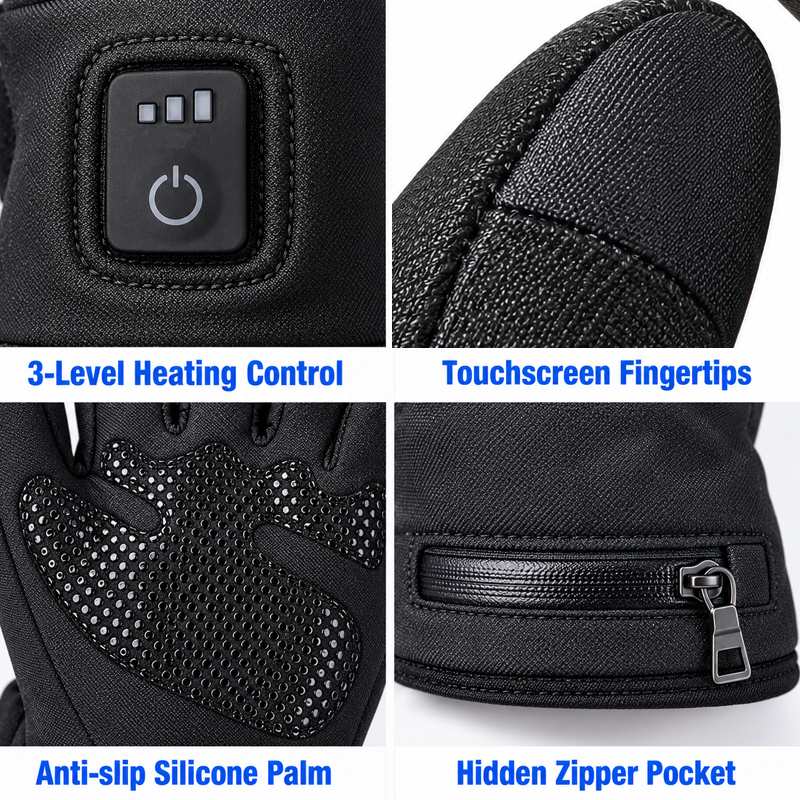
- The button, pressed while wearing the glove. If it needs a bare hand, the design has already failed for riding and skiing — removing a glove at -5°C undoes twenty minutes of heating. Check the press force, and whether a gloved thumb finds it without looking.
- The touchscreen, tested cold. A glove that works on a phone in a warm office proves nothing. Conductive yarn has to sit over the fingertip pad, the lining has to transmit pressure, and the fingertip has to be close-fitting — a loose fingertip is the usual reason a “touchscreen glove” stops being one outdoors. Our touchscreen test on a motorcycle shows what cold does to the same material.
- The palm, gripped. Silicone or leather stops a ski pole or a handlebar sliding. It also adds thickness, which costs feel and a little heat transfer — a trade worth seeing in the hand, not in a specification.
- The battery pocket, opened with the glove on. One-handed access matters if the pack comes out indoors. Look at where the zip sits, whether it has a storm flap, and whether it opens into the sealed cuff volume.
6. Left and right will not match unless the factory tests it
A glove is the only heated product built in handed pairs, with two element runs, two terminations and two packs. That creates a failure mode no other heated garment has: a pair that is individually acceptable and mismatched as a pair.
If one element run is slightly longer than the other, its resistance is slightly higher, so it draws slightly less power, reaches a lower temperature and drains its pack more slowly. The wearer reports this as “the right glove is never as warm as the left”, which gets logged as a controller fault far more often than as a pairing problem. When a single finger fails instead, the cause is different and usually physical, as covered in our guide to gloves that stop heating.
Four production controls close the gap, and a buyer can ask for all four: resistance measured on every single glove rather than by batch sample, a stated pairing tolerance between left and right, a burn-in test that runs both channels together rather than one at a time, and pairs boxed and numbered together so a return traces back to a specific run. None of it appears on a normal specification sheet, and it is the most useful thing to add.
7. The numbers that decide the quote
An enquiry that gives all of the following gets comparable quotations. An enquiry that gives a glove type and a target price gets quotations that cannot be compared, because each supplier fills the gaps with the cheapest option available.
| Parameter | What to write | Why it moves the price |
|---|---|---|
| Glove type | Full finger, mitten or liner | Pattern, lining and number of element runs |
| Heating area | Palm and fingers, full hand, or back and thumb | Element length and power draw move together |
| Element type | Alloy wire, carbon fibre or etched foil | Material cost, and the flex life you can claim |
| Pack | 3.7V at 2,200, 2,500, 3,200 or 5,000mAh; 7.4V at 2,200, 3,000 or 4,000mAh | Cell count and protection board |
| Charger | 5V 2A on the 3.7V platform; 8.4V 1.5A on the 7.4V platform | A slower charger is cheaper and lengthens the charge time the box has to admit to |
| Control | Single button with three levels, dual switch, or app control | Each extra channel and each wireless option adds a board |
| Ingress protection | IPX4 as standard, IPX5 as an option | Sealing method and testing time |
| Sizes and quantity | S to 3XL, with the quantity split by size | The size split decides cutting efficiency; MOQ is 100 for OEM, 500 for ODM and 1 for stock |
| Time and warranty | Sampling 7 to 30 days, OEM 20 to 25 days, ODM 50 to 60 days, mass production within 45 days, 12-month warranty | A compressed schedule is paid for in overtime or in testing that gets skipped |
8. How two quotes that look identical differ
A quotation fifteen percent below another is not usually cheating. It is built differently, and the difference sits in one of five places: one finger run omitted from the heating pattern, a pack one capacity step down, an analogue controller instead of a digital one, no per-unit resistance test, or simpler packaging and no branded manuals.

Three questions settle it: the element layout drawing with the length of each run, the exact pack model with its watt-hour figure, and the outgoing inspection list with one line per test. A supplier who can produce all three is quoting a product; one who cannot is quoting a shape. Sampling is the only place to confirm any of it — the sequence is in our walkthrough of heated glove manufacturing, and the commercial terms are in the MOQ and lead time guide.
Dr. Warm builds heated gloves for brands, distributors and retailers on 3.7V and 7.4V platforms, with element layout, pack and charger matching, cuff construction, per-unit testing and retail packaging developed as one specification rather than four purchases. The compliance file behind a glove order covers CE, UKCA, UL, FCC, RoHS, Reach, UN38.3, DOE, ISO 9001 and GB 47372-2026 with CCC — the certification list for heated gloves explains which document applies to which market. If a specification review would help, send the intended use, the market and the quantity, and we will quote against the seven points above through our OEM and ODM service. The finished range is on our heated glove category page.
Frequently Asked Questions
Does a higher wattage heated glove heat up faster?
Not necessarily. Wattage sets the steady-state temperature and how quickly the pack drains, but felt warmth depends on how close the element sits to the skin and how much insulation is between them. A high-power element behind a thick liner can feel slower than a lower-power element bonded close to the hand. Ask for the time to reach the glove’s rated surface temperature, measured on a hand or a heated dummy, rather than for the wattage alone.
Is IPX4 enough for skiing and motorcycle riding?
For most winter use, yes. IPX4 covers splashing from any direction and IPX5 is available where more is needed, but the rating tests the fabric and the seams. The water that actually reaches a wearer arrives at the wrist opening: snow melting on a warm cuff, or rain running down a sleeve. A glove with IPX4 and a closed, tightened cuff stays drier than an IPX5 glove with an open gauntlet, so inspect the cuff before comparing ratings.
Why does only one glove or one finger stop heating?
Fingers are usually wired in series, so a single break at the knuckle takes out the whole finger while the rest of the glove keeps working. A whole glove going cold points at the connector, the controller channel or the battery contact instead. When left and right differ rather than fail, the usual cause is a pairing tolerance in production rather than a fault, which is why per-unit resistance testing belongs in the purchase specification.
How many heating zones should a heated glove have?
Count the back of the hand, the five fingers and the palm as separate areas and most gloves come out at three to five zones. The number is not a quality score by itself: what matters is whether each zone has its own element run and whether the controller can drive them separately. For most winter markets, back of hand plus fingers is the floor, and adding the palm is what separates a glove that works at -10 degrees Celsius from one that only delays the cold.