
The question sounds like it is about the insole. It is not. Comfort in a ski boot and comfort in a work boot are decided by two different kinds of space, and an insole that is comfortable in one is often unbearable in the other. A ski boot is a rigid shell with no spare volume; a work boot is a soft upper with room to give. Same product, two opposite sets of limits.
Two boots, two kinds of space
A ski boot is designed to hold the foot still. The shell is rigid, the liner is dense, and the buckles compress everything inside by design. Any insole added to that system has to earn its volume back — and it does that by pressing somewhere. The usual somewhere is the top of the toes, because that is where a ski boot has least room.
A work boot is the opposite: a soft upper that moulds to the foot, a sole thick enough to insulate from frozen ground, and a toe cap that already occupies the front of the shoe. What a work boot does not have is heat. A steel or composite toe is a cold bridge, and eight hours of standing on a cold slab pulls warmth out through the sole faster than a foot can replace it.
| Constraint | Ski boot | Work boot |
|---|---|---|
| Spare volume | None — the liner fills the shell | Some, especially in the width and instep |
| What compresses the fit | Buckles, closed by design, every run | Laces, adjusted by the wearer |
| Where the cold comes from | The snow under the shell, and the boot being cold-soaked between runs | The slab, and the metal toe cap acting as a cold bridge |
| Wearer’s heat output | High on the descent, near zero on the lift | Low and steady for a whole shift |
| Risk of the change | Toe pressure, heel lift, a liner that no longer packs out the same way | Instep pressure, lost arch support, a looser heel |
| Runtime needed | A ski day, in bursts | Eight to twelve hours, continuous |
The ski boot test, done the way a bootfitter does it
The mistake almost everyone makes is measuring the boot with the buckles open. A ski boot has to be measured closed, because that is the state it works in. With the liner in and the buckles at riding tension, press down on the top of the toe box; there should still be a few millimetres of give. If the shell is hard against the toes with the original footbed, there is no room for an element and no insole will fix it — that boot needs a thinner liner or a different shell, not a heated insole.
The second test is the heel. Put the insole in, close the buckles, and stand with weight forward as if skiing. If the heel lifts now and did not before, the insole has taken up the volume that held the heel down. That is not a comfort preference — a lifting heel in a ski boot is a control problem, and it appears on the first run rather than on the walk to the lift.

The work boot test: it is about the toe cap and the shift
In a work boot the volume question is easier and the endurance question is harder. A safety boot usually has enough room for an insole if the original is removed, and most work boot wearers are already used to swapping insoles for arch support. What it does not tolerate is a pack that runs out at hour five. A shift is eight to twelve hours, and the cold does not stop at lunch.
Two practical notes for this boot type. First, a steel or composite toe cap conducts cold straight to the toes; heat under the forefoot matters more here than heat under the arch, because the toes are the part with a cold bridge attached. Second, a work boot is worn with the laces done up tight for ankle support — adding volume under the instep raises the foot into the lacing and produces the pressure point that gets reported as “the insole is uncomfortable” when the real cause is that the boot was already a close fit.
Comfort complaints, and what each one actually means
| What the wearer says | What it is | Fix |
|---|---|---|
| “My toes are numb and cold” | Toe box pressed; the element has nowhere to sit | Thinner build, or trim to the liner line, or a different boot |
| “My heel lifts when I ski” | Volume taken from the heel pocket | Insole back to the original thickness at the heel, or re-heat-mould the liner |
| “The top of my foot aches” | Instep raised into the lacing or the buckle | Remove the original insole before fitting; loosen the lower buckle one notch |
| “The heat fades by mid-morning” | Capacity, not comfort — the pack is undersized for a shift | Larger pack or a second one, and a low level held all day |
| “It felt fine in the shop” | Tested warm and standing still; real use is cold and moving | Test with the boot cold and buckled, for twenty minutes, walking |
One insole, two boots? Usually not
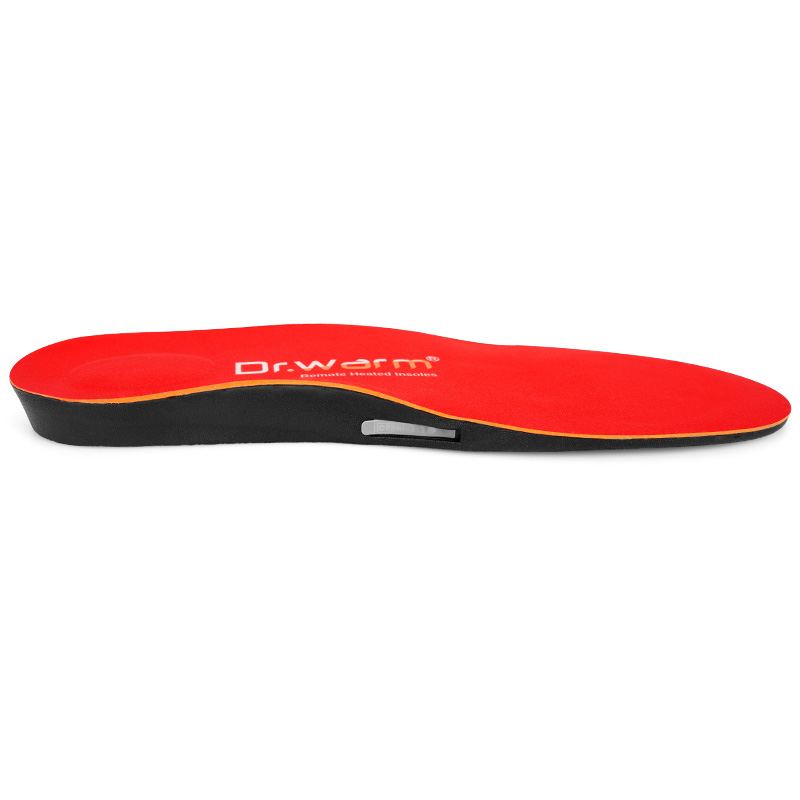
Cut-to-fit insoles are trimmed to a shoe size, and once trimmed they do not go back. A pair trimmed for a ski boot liner will not sit correctly in a work boot, and trimming to the larger of the two leaves the smaller boot with a folded edge — which is exactly where a conductor creases. Wearers who want both should buy two pairs and keep each trimmed to its boot. For a brand, that is also the honest way to propose a two-SKU range rather than one SKU that disappoints in half its applications.
Safety boots: what a heated insole does and does not change
A safety boot’s certification belongs to the boot — the toe protection and slip resistance are tested on the footwear, to standards such as EN ISO 20345, and adding an insole does not add to or subtract from that certification. What an insole can change is fit: a raised instep, a looser heel or a compressed toe are real effects on how safely the boot is worn, even though no certificate is affected. That is why the fit tests above matter in a work boot as much as in a ski boot, and why a brand should document the maximum insole thickness it recommends for a given boot class rather than leaving it to the wearer.

Five questions to ask before specifying a pair
For a brand building a range for both boot types, the specification questions are the same five, and the answers differ by boot. Getting them settled at the sample stage is far cheaper than discovering them in returns.
- What is the base thickness at the forefoot? Not the average — the forefoot figure, because that is where a ski boot has least room. A slim base profile is a specification, not a marketing word.
- Where is the trim line marked, and is it inside or outside the element? A line that runs outside the conductor can be trimmed safely by a retailer; one that runs over it cannot, and the failure will arrive as a warranty claim.
- Is the pack exchangeable without tools? For work boots the answer decides whether a shift is covered; for ski boots it decides whether a second pair of packs is worth stocking.
- What IP rating is standard, and what is optional? IPX4 as standard and IPX5 optional is a normal split; the answer should match how wet the boots actually get, not the highest number available.
- Can the same platform be supplied in two thicknesses? One SKU rarely fits both a hard-shell liner and a safety boot. Two builds from one platform is the version that sells.
Custom heated insoles for ski and work boot ranges
Dr. Warm builds 3.7V and 7.4V heated insoles in cut-to-fit and fixed-size versions, with a slim base profile for hard-shell boots, remote or app control, IPX4 as standard and IPX5 optional. Documentation covers CE, UKCA, IEC 62133, UN38.3, RoHS, REACH and GB 47372-2026 with CCC for the Chinese market; OEM from 100 pairs, ODM from 500, 12-month warranty.
Frequently Asked Questions
Are heated insoles comfortable in ski boots?
Only if the boot has room in the toe box, measured with the buckles closed rather than open. Press down on the top of the toe box with the liner in and the buckles at riding tension; if there is no give left with the original footbed, an element under the forefoot will press the toes. That boot needs a thinner liner, not a thicker insole.
Will a heated insole change how my work boots fit?
Yes, and the change is predictable. Removing the original insole and replacing it keeps the volume close; stacking the heated insole on top of the original raises the foot into the lacing and creates instep pressure. Most work boots also lose arch support in the swap, which the wearer notices as fatigue rather than as cold.
Can I use one pair of heated insoles in both ski boots and work boots?
Not once they are trimmed. Cut-to-fit insoles are trimmed to a specific size line, and a pair cut for a ski boot liner will not sit correctly in a work boot. Trimming to the larger boot leaves the smaller one with a folded edge, which is exactly where the conductor creases. Two pairs, each trimmed to its boot, is the workable answer.
Do heated insoles affect safety boot certification?
No. Toe protection and slip resistance are certified on the footwear itself, to standards such as EN ISO 20345, and an insole neither adds to nor subtracts from that certificate. What an insole can change is fit — a raised instep, a looser heel, a compressed toe — and those affect how safely the boot is worn even though no certificate changes.