Both products are sold as “warm insoles”, and neither is an upgraded version of the other. One reflects heat the foot is already making; the other makes heat with a battery. That difference is small on a spec sheet and decisive in a boot, because an insole is the only part of heated apparel that is fully enclosed — above by the foot, below by the sole, in front by the toe box, behind by the heel counter. Heat has nowhere to go except into the foot, and space has nowhere to come from except the shoe.
Two ways to keep a foot warm, and only one has a battery
A thermal insole is a passive layer: a reflective film plus closed-cell foam that returns the heat the foot produces. It works while the foot produces heat — walking, climbing, working — and it stops working when the foot stops, which is exactly when a hunter sits down or a worker stands still at a cold-store dock. A battery heated insole does not depend on the foot at all. It generates heat from a pack, so it keeps working through a two-hour sit at minus fifteen.
The second difference is what each one asks of the shoe. A thermal insole is a thin sheet and behaves like the original insole. A heated insole carries an element, a connection and, in most designs, a battery lead at the heel — so it occupies volume the original insole did not. That is the trade a buyer actually makes, and it is why the comparison below is organised around space and structure rather than around temperature.
| Dimension | Regular thermal insole | Battery heated insole |
|---|---|---|
| Heat source | The foot itself, reflected back by foil and foam | A heating element driven by a rechargeable pack |
| Needs charging | No | Yes — 3.7V or 7.4V pack, 2200 to 5000mAh by model |
| Volume in the shoe | Close to the original insole | Element plus a battery lead at the heel; noticeably thicker |
| How long it works | As long as the foam holds its rebound — usually a season or two | Per charge, model and level dependent; a spare pack covers a shift |
| How it fails | Compresses flat, the reflective layer creases through | Cell ages, connector corrodes, element creases at the fold line |
| Care | Usually washable by hand | Wipe clean; IPX4 as standard, IPX5 optional |
| Compliance load for a brand | None beyond textile rules | CE, UKCA, IEC 62133, UN38.3, RoHS, REACH, and GB 47372-2026 with CCC for the Chinese market |
The four measurements that decide it
None of the four is about wattage, and all four are taken with the shoe on a bench and a ruler in hand.
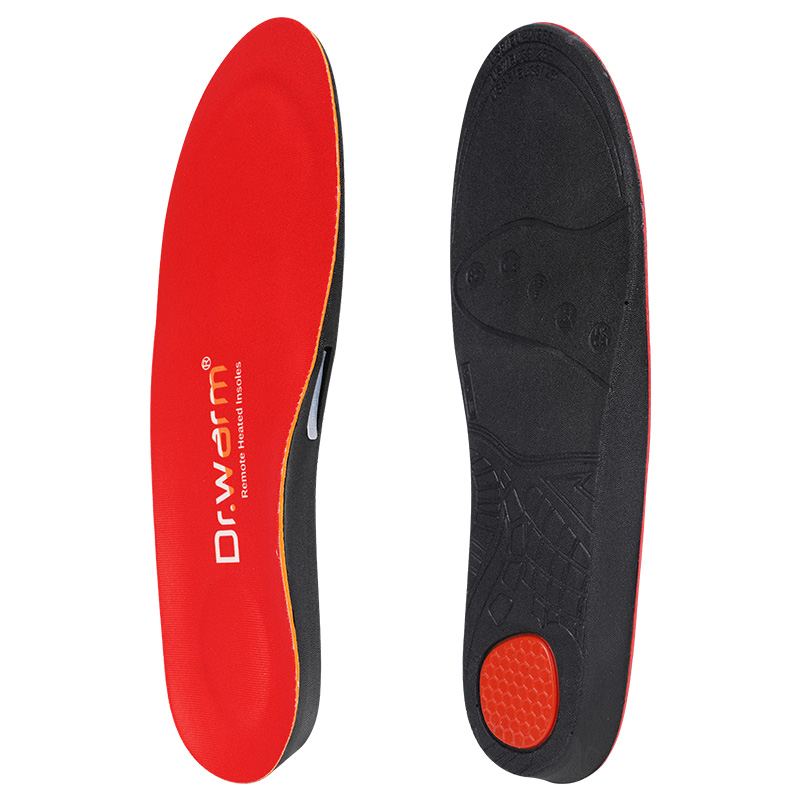
- Toe box height. Press a thumb on the top of the toe box while the shoe is laced. If there is no give, an insole with an element under the forefoot will press the toes and cut comfort — this is the single most common reason a heated insole “does not work” in a race-fit ski boot.
- Heel depth. The heel is where the battery lead and the connection sit in most designs. A shallow heel cup lifts the foot out of the shoe and lets the heel slip, which produces blisters long before it produces cold.
- Sole stiffness. A stiff, thick sole insulates from the ground; a thin, flexible sole conducts. Against frozen ground, a thermal insole on a thin sole loses heat faster than it can reflect it, and that is where a heated insole earns its place.
- Moisture. Every insole in this comparison fails when the inside of the shoe is wet. A foot sweats through a working day, and a wet foam layer stops insulating and starts conducting. Whichever product is chosen, the insole comes out at night and dries.
Where regular thermal insoles genuinely win
Four cases, and they are not edge cases — they are the majority of winter footwear sold.
- A tight, race-fit boot. Adding volume to a boot that has none presses the foot and squeezes the toes, and leaves them colder than before. A heated insole cannot overcome a boot that has no room for it.
- A shoe whose insole carries the support. In work boots and walking shoes the original insole often provides the arch and heel support. Replacing it with a heating product removes that, and the buyer notices in the first week — not as cold, but as fatigue.
- A wearer who will not charge anything. A thermal insole is always ready. A heated insole that is left uncharged is a thicker, heavier insole with no benefit at all.
- A brand shipping into markets with battery documentation rules. Shipping a passive insole carries no cell documentation, no air-freight paperwork and no charger. For a small private-label range, that alone can decide the line.
Where heating wins, activity by activity
The dividing line is simple: does the wearer keep producing heat? If the body is working, a good thermal insole is often enough. If the body is still, in the cold, for hours, nothing passive will hold — the foot has no heat to reflect.
| Activity | Is the foot producing heat? | What wins |
|---|---|---|
| Sitting hunt in deep cold | No — the body is still for hours | Heated, low level, large pack |
| Skiing and lift rides | Intermittent; the boot is cold-soaked between runs | Heated, if the boot has toe box room |
| Cold store and static site work | Low and steady on a hard, cold floor | Heated, with a swappable pack |
| Winter hiking | Yes, continuously | Thermal is often enough; heated is a comfort upgrade |
| Commute under an hour | Yes, walking to and from transport | Thermal, and a warm sock does more |
| Wet slush, all day | No — the shoe is wet inside | Neither; fix the shoe first |

The two mistakes that ruin either choice
Stacking. A heated insole placed on top of the original insole takes twice the volume and half the room. The foot rides high, the heel slips, the laces have to be loosened, and the extra height presses the instep. Either the original comes out, or the heated insole is trimmed to replace it — most cut-to-fit builds are marked to be trimmed at the toe, not at the heel, because the heel carries the element and the lead.
Wet storage. Both products share one failure that has nothing to do with electronics: an insole left in a boot overnight in a cold hallway never dries. Foam holds the moisture, the reflective layer stops reflecting, and the element sits in damp. Pulling them out at night costs ten seconds and is the single biggest difference between a product that lasts two seasons and one that lasts five.

What it costs over three seasons
Compare the two on purchase price and the thermal insole wins every time. Compare them over three winters and the picture depends on use. A passive insole compresses flat in a season of daily wear and gets replaced; two or three pairs over three winters adds up. A heated insole costs more once, but the garment side does not wear out: the pack is replaceable, and where the design allows a second pack, the same insole covers a double shift.
The practical rule for a buyer: count the days. Under about thirty days of wear a winter, in a shoe that is walked in rather than sat in, a thermal insole is the better buy and there is no reason to carry a charger. Over that — or any use where the wearer stands still in the cold — the heated insole is the only one of the two that is still working at hour three.
Custom heated insoles for outdoor and workwear ranges
Dr. Warm builds battery heated insoles in 3.7V and 7.4V, cut-to-fit and fixed-size, with remote or app control, IPX4 as standard and IPX5 optional. Documentation covers CE, UKCA, IEC 62133, UN38.3, RoHS, REACH and GB 47372-2026 with CCC for the Chinese market, with a 12-month warranty. OEM from 100 pairs, ODM from 500.
Frequently Asked Questions
Are heated insoles warmer than regular thermal insoles?
It depends on whether the foot is producing heat. A thermal insole reflects heat the foot already makes, so it works while the wearer is walking or working and stops being effective when they stand still. A battery heated insole keeps generating heat through a long sit, which is why it wins in hunting blinds, lift queues and cold stores.
Can I use heated insoles in tight ski boots?
Only if the toe box has room. Press a thumb on the top of the toe box while the boot is laced; if there is no give, an element under the forefoot will press the toes and leave them colder than before. In a race-fit boot, a thin thermal insole is usually the better choice.
Do thermal insoles work in wet shoes?
No. Once the foam is wet it stops insulating and starts conducting, and the reflective layer has nothing to reflect. A heated insole does not fix this either. Dry the shoe and the insole overnight, and treat waterproofing as a separate problem from warmth.
How long does a heated insole battery last per charge?
It depends on the model, the capacity and the heat level. Dr. Warm builds 3.7V packs from 2200 to 5000mAh and 7.4V packs up to 4000mAh, and the runtime for each is stated per model. For a full shift in a cold store, plan on a second pack rather than a larger one.